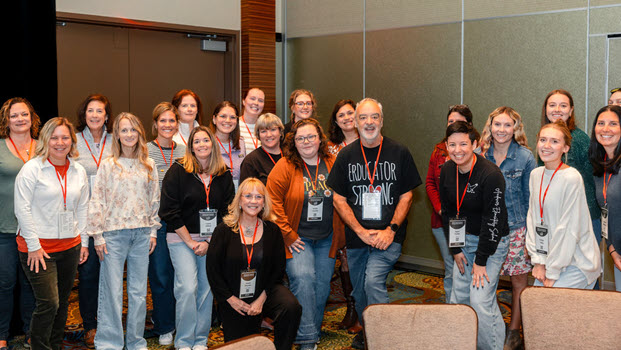
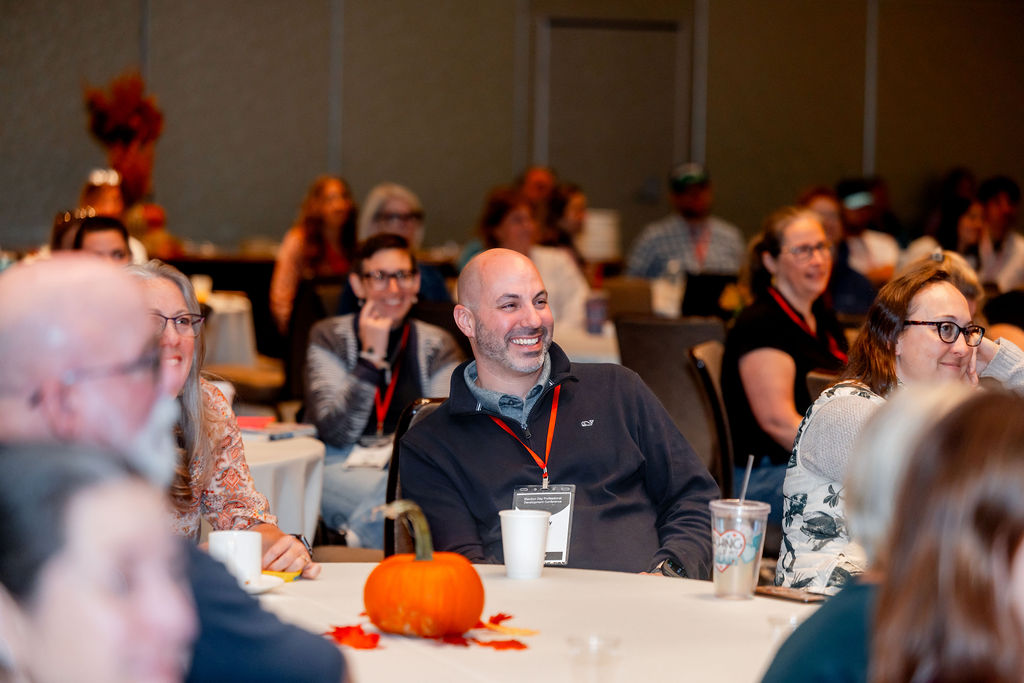
Not only did Connecticut educators turn out at the polls this Election Day, but hundreds also gathered at Foxwoods for a day of professional development at CEA’s annual Reimagining Education conference, whose theme centered on connecting, engaging, and inspiring school communities.
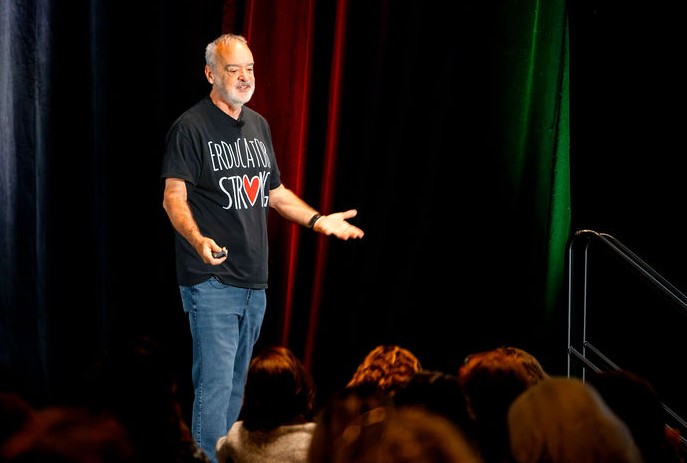
Keynote speaker and educator-comedian Gerry Brooks, best known for his viral YouTube and TikTok videos, brought CEA members to tears not only with his signature humor but also with poignant—and often personal—examples of what happens when we show up for our students and each other.
Sharing in the joy
“We started this professional development conference a few years ago with the goal of bringing joy back to our profession and with the foundational belief that joy is what drives us,” said CEA President Kate Dias. “There are so many things that threaten to push us out, but joy keeps us in. And today, we have the added joy of being with colleagues and friends who prop us up and do this work alongside us.”
Introducing Brooks, she said, “I can think of very few people who have such a clear understanding of how important it is to laugh and find the joy in what we do, and Gerry puts a fine point on the often ridiculous, often hilarious aspects of that work.”
 Brooks, whose videos poke fun at the everyday realities of being a teacher—from interactions with pre-K-12 students to parents to admins—said, “I have two goals for you today. The first is for each of you, as individuals, to walk out of here with something you can use to get you through your school year. The second is for your team: for the third-grade teachers who aren’t here, for the special education teachers, for the English department—whoever you consider your work family, share something with them.”
Among his tips for fellow educators:
Create a work family. Build relationships with people who do the same work as you and who know the particular challenges. Are you a “lone ranger” in your building—the only library media specialist, school counselor, or physical education teacher? Get active with professional associations, including your union, and find your people.
Remember, we’re in it together. Brooks noted that people who don’t work in education often “don’t get” the daily realities that include stranger-than-fiction interactions and requests, the mysterious brown smudge on your arm that could be…(please, let it be) chocolate, and more. Finding the humor in the everyday builds resilience and camaraderie.
 Notice the ties that bind. “You may work with people who don’t vote like you or worship like you, but here’s how easy it is to get along,” said Brooks. “All you have to do is remember how much you have in common with everyone you work with. Did you know everyone you work with is getting up and putting in six, seven, eight or more hours a day to raise someone else’s child? Your custodians, your bus drivers, your secretaries, your fellow teachers down the hall—everybody you work with has made the exact same decision you made: ‘I’m going to dedicate my life to someone else’s child.’ I understand you’re working with people who are not like you, but I’m going to tell you something more important. You’re working with people who are exactly like you.”
Treat your work family as your team even when you have differences. “You expect your students to overcome their differences and collaborate on goals and projects, and you need to do the same—because guess what?” said Brooks. “Those kids are watching you.”
Build the positive culture your school needs. You can change the climate and culture of your building by communicating, focusing on the positive, and being a participant instead of a bystander. Find ways to get on the same page and remind yourself that just because you have a right to say something doesn’t mean it’s the right thing to say.
 The stories that stick
Leaning on his trademark candor and humor, Brooks shared some of the challenges he faced growing up poor in a home with an abusive parent.
He told the story of one Christmas, when his grandmother—who crocheted slippers for every family member—let each child choose their own color. Brooks chose purple. When it came time to open gifts, he reached into his stocking for his slippers so that he could wear them while everyone else unwrapped their treasures.
Enraged at what he saw—and using a homophobic slur about purple for boys—his father tore the slippers off his feet, dropped his son to the floor, and threw the slippers in the trash before driving off.
Brooks retrieved his grandmother’s crocheted slippers from the trash, washed them, put them back on wet, and covered them up with long white socks before going to bed. The next morning, he woke to see his feet dyed purple and couldn’t wait to show his classmates.
“We were poor, so when our teachers asked everyone to describe their favorite holiday gifts, I could never compete,” he recalled. “But that year, I had purple feet and a great story—and being the class clown, I couldn’t wait to tell it.”
 Though his recollection of that Christmas got the laughs he was looking for, Brooks remembered seeing his teacher at the back of the room crying. Afterward, she told him she’d put something in his school bag for him to open later—not on the bus, where other kids could see, because she didn’t have something for everyone.
“Of course I opened it as soon as I got on the bus,” he chuckled.
What she had left him—and what he held up for CEA members to see—was a copy of the 1955 classic children’s book Harold and the Purple Crayon, about a boy who uses a purple crayon to draw his own world.
“My teacher kept showing up for me,” Brooks continued. “She came to my extracurriculars. My graduation. She sent me five dollars every month when I was in college so that I could treat myself to McDonalds. And when she died, I spoke at her funeral.”
‘Suriously’ good
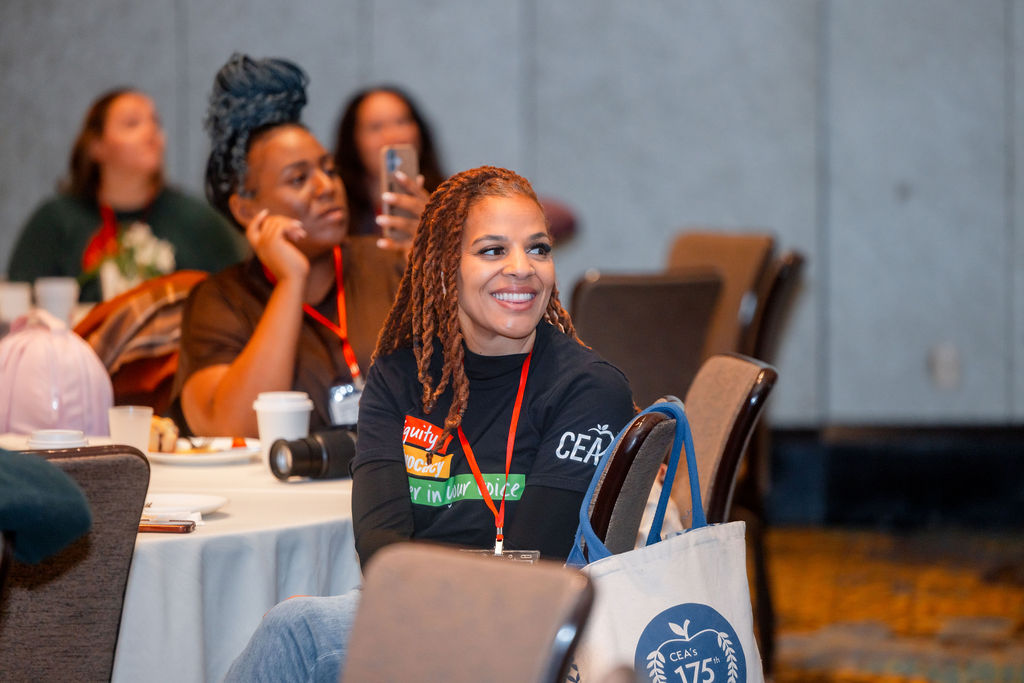
“Being in the same room with people who have the same daily struggles, where everyone gets it, reminds you that you’re not alone,” said New London elementary school teacher Bailey Francisco, adding that many of her students have encountered childhood struggles similar to the one Brooks described.
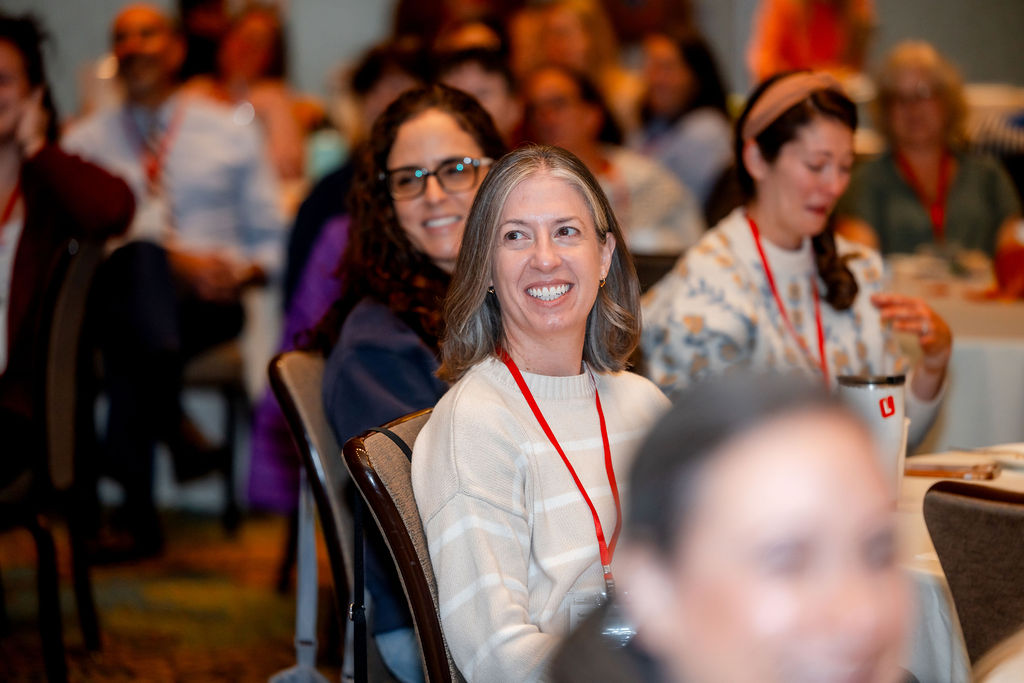 Trumbull High School biology teacher Pat Tivadar and her teacher bestie often binge Gerry Brooks over lunch, and being able to see him live was a big draw.
“CEA’s Election Day PD is so always so energizing and inspiring,” she said, noting that she’s equally appreciative of the day’s learning opportunities. On her agenda was a workshop led by Brooks, taking a deeper dive into positive school climate, as well as a session on using artificial intelligence effectively in education.
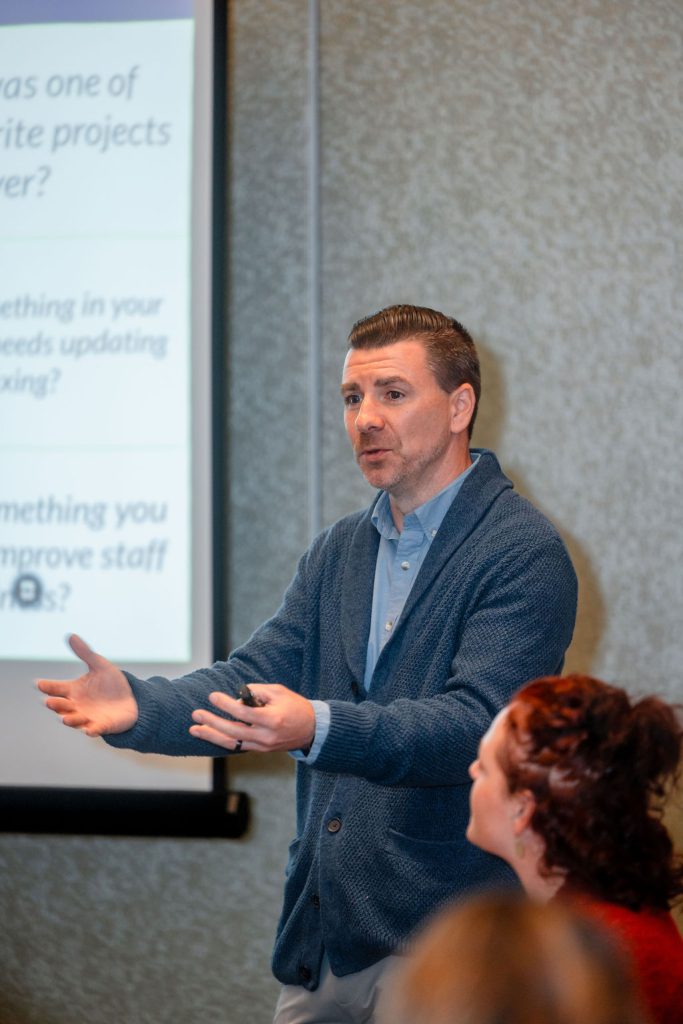
Having deployed AI in student-friendly ways that she says have improved comprehension around genetics, evolution, photosynthesis, and other complicated topics, Tivadar was keen to learn more. “The Productive Struggle: Human-Centered Learning in the Age of AI,” a workshop led by 2026 Terryville Teacher of the Year and state finalist Kate Avcollie, explored how to design learning experiences that balance AI innovation while preserving creativity, critical thinking, collaboration, and authentic relationships in increasingly digital classrooms.
 Other session topics included
- Teaching authentic vulnerability in the age of curated certainty
- A blueprint for inclusion for special education
- Designing experiences that build connection, community, and joy outside the classroom
- Gamifying the math mindset
- Conferencing formative assessments in math
- Cultivating a sense of belonging in school
- Engaging every sense and every learner
- Mentoring new teachers
- Establishing play, purpose, and high expectations for students
- Creativity through art
- Student engagement through empowerment
- Building relational capital to transform classrooms
- Strategies that boost paraprofessional success and reduce stress when working with students with emotional or behavioral disorders
- Physical education for kids who hate sports
In addition to PE and health teachers, this last workshop also drew educators in art, music, and other specials.
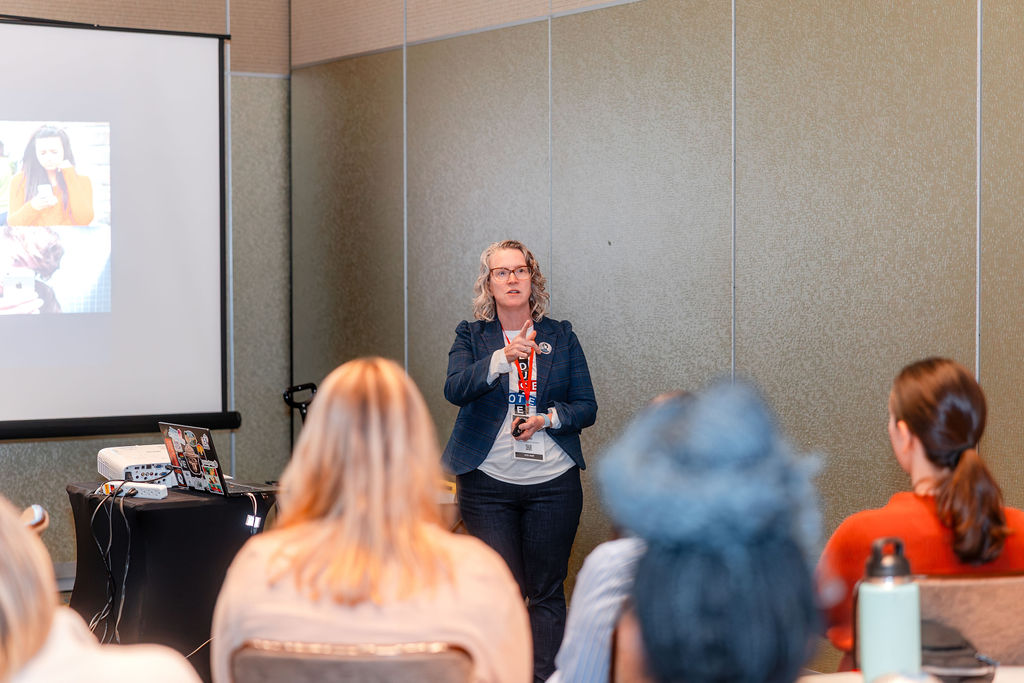 Andover music teacher Julie Gourdet finds that a fair number of students shrug off music or physical education, saying, “I’m not good at this, or I’ll never play, so why should I learn?”
In the workshop, she said, “We talked about how mastery isn’t necessarily the point, because students can still understand and reap the benefits, they can feel joy and passion about music or movement, which provide opportunities for creativity, self-expression, and healthy habits.”
Montville High School social worker Michael McGovern came to the conference with a team of student support service providers from his district, including school psychologist Jillian Filler and school counseling director Kristen Raulerson.
While Montville has what Raulerson describes as a high-needs student population, she notes that the district also has an “enviable ratio of students to support service providers and an emphasis on mental health services.”
“We all saw this as a huge opportunity to do something outside the district, and we loved starting our day with some laughter,” said McGovern. “The workshops gave us something to build on when it comes to new ways of integrating student support into our practice. We’re all going to different sessions, which is an advantage, because then we can come together afterward and exchange notes on what each of us learned.”
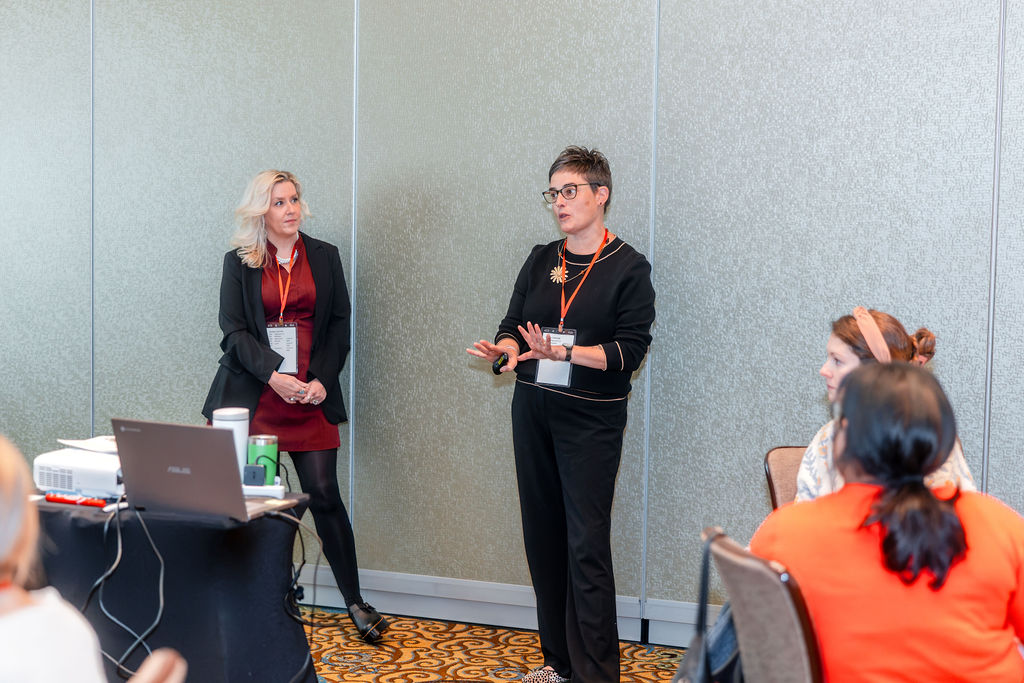 Other teachers described working in districts stretched thin.
“I travel on a cart and teach more than 200 students,” said one educator. “The school climate is poor on the best day, and many of us are spinning our wheels. We keep going for the kids, but sometimes it feels like it’s not enough. We’re here looking for practical strategies, renewed hope, and union strength—because we really do feel like CEA and our local association have our backs.”
“Having taught in two very different districts myself, I like the various perspectives and experiences that teachers from other districts bring,” said New London math, science, and social studies teacher Aaron Vaughn. “I look for things I can take home with me. It’s easy to sit in your own district and have your professional development there, but it’s better when we can come together like we do here and talk about what works, what doesn’t, what it’s like with different demographics, and so on. This is a unique experience.”
The conference also welcomed a number of first-time attendees.
Cromwell seventh-grade special education teacher Georgann Stokes, who plans to form a school-based club called Best Buddies, came to learn strategies for including students with special needs in the classroom and school community. Fellow first-timer Christine Parsons, a Ridgefield second-grade teacher, was eager to learn ways of engaging and differentiating for young elementary students in an age of lit screens, packed schedules, and little downtime.
Looking for your next PD opportunity? CEA hosts its annual Early Career Educator Conference on April 3 at Mohegan Sun, so save the date.