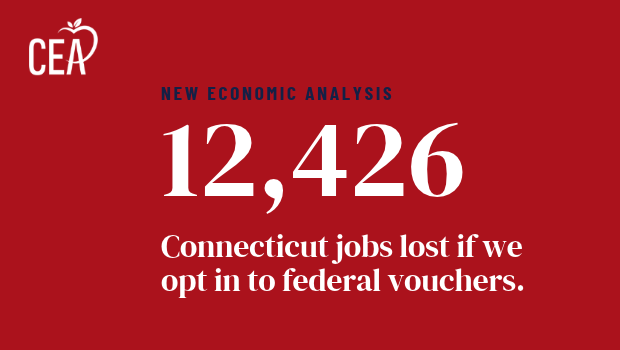
More than 12,000 fewer jobs, a $1.7 billion drop in GDP, and a $2 billion loss in personal income—that’s what Connecticut faces if the state adopts the Trump administration’s school voucher scheme, known as the Federal Scholarship Tax Credit (FSTC), set to launch in 2027. Governors have until January 1 to opt in.
An analysis using Regional Economic Models, Inc., or REMI—an advanced economic modeling tool that utilizes federal and site-specific economic data—projects that the FSTC would not only unfairly advantage the wealthy and threaten the fiscal health of public schools but also wreak havoc on the state’s economy. REMI is a highly regarded economic impact analysis tool used by federal and state agencies, universities, and economic development advisors.
Consider the compounding effects of the Federal Scholarship Tax Credit:
- Fewer jobs. Over the next decade, the FSTC is projected to erase nearly 8% of the state’s employment growth, costing Connecticut 12,426 jobs, including an estimated 5,000 jobs in construction, retail, professional services, food services, and other private-sector industries.
- Lower personal wealth, income tax receipts. The projected loss of jobs translates to $2 billion in lost personal income and a decline of $1.7 billion in disposable income.
- No offsetting growth. The credit fails to lift Connecticut’s GDP or employment above the baseline in any year. Whatever private donor dollars flow in, the state does not get economic expansion in exchange—which removes the central argument for opting in.
- Fixed costs in public education. School districts cannot scale down proportionally when enrollment falls. The costs associated with school buildings, transportation fleets, special education mandates, and administrative functions remain as per-pupil revenue declines—even more acutely so for Connecticut’s many small districts.
There are several misconceptions about the tax credit, including that it’s “free money,” that it will benefit public schools, and that states that refuse to opt in will lose out to other states accepting those tax credits. None of those arguments holds up.
The fact is the tax credit voucher program is funded using public dollars. Money that would otherwise be paid in state or federal taxes will instead go to scholarship granting organizations (SGOs), most of which support private schools and private educational services. The idea that public schools can benefit by setting up their own SGOs is misleading; existing SGOs have a massive advantage, including an established infrastructure, and the money coming out of SGOs goes to individual students—not public schools. Furthermore, states are not allowed to mandate that those funds go to public school students.
“The federal tax credit is not free money for Connecticut, and the supposed fiscal logic that makes the program look attractive does not hold up,” says CEA President Kate Dias. “What’s more, the tax credit serves as a subsidy for families already able to afford private tuition at the same time it reduces revenue available to schools serving everyone else. Connecticut has struggled to close one of the widest, most persistent school funding and achievement gaps between its wealthiest and poorest districts. This voucher scheme would create even greater wealth disparities and educational inequities.”
In addition to the economic harm modeled by REMI, a broad body of independent research on school voucher programs demonstrates an erosion in educational outcomes. Among those studies, a multi-state analysis by Public Funds Public Schools, the Education Law Center, and the Southern Poverty Law Center found that in states with expansive voucher programs, public investment in K-12 education declined as a share of GDP even as enrollment increased, creating structural funding gaps in public schools. Furthermore, a survey in the Journal of Economic Literature found that the evidence of academic gains from voucher programs is mixed and, for large-scale programs, weak—undermining the argument that the program’s private schools deliver better results.
“The next year will be a litmus test for states that have opted into the federal voucher scheme,” says Dias. “Connecticut recently ranked 7th in the nation in real GDP growth per capita and consistently ranks in the top three for education. We’re urging Governor Lamont not to experiment with our future, our economy, or our public schools.”