
More than 600 teachers this week reached out to lawmakers urging the passage of a comprehensive bill containing key recommendations from CEA for supporting teachers, students, and public schools. Dozens more are testifying live today—many in person, others via Zoom—as the legislature’s Education Committee considers two significant proposals, House Bills 6884 and 6881, that would increase educator salaries and address other critical barriers to teacher recruitment and retention.
Ahead of the committee’s public hearing that opened at noon, CEA held a press conference outlining the importance of these bills.
 “This landmark legislation would reverse decades of policies that have led to teacher attrition, a shrinking teacher pipeline, a lack of ethnic and racial diversity in the profession, poor working conditions, and pay that has not kept pace with other professions,” said CEA President Kate Dias.
Escalating duties and responsibilities
Since the pandemic, work-related issues for teachers have exploded, including greater responsibilities due to staffing shortages, increased exposure to dysregulated and violent student behaviors, and harassment for teaching American history that includes the Civil War, slavery, racism, and bias.
An October 2022 CEA survey of teachers, which put the crisis into perspective, found that
• Nearly 3 in 4 teachers are dissatisfied with the many difficult conditions they encounter daily
• Nearly all teachers said stress and burnout were a serious concern
• 3 in 4 teachers are planning to leave teaching earlier than previously planned
 “It is long past time for Connecticut to take care of its educators,” said 2019 Connecticut Teacher of the Year Sheena Graham, who retired early due to burnout caused by the pandemic. “These bills are a step in the right direction. I support House Bill 6884, because it shows teachers that theirs is a respected profession.”
HB 6884 and HB 6881 call for the following provisions, among others:
• A statewide minimum teacher salary and funding for salary increases
• COVID pension benefit enhancement
• Teacher tax credits
• An end to edTPA, the ineffective assessment of teaching performance required of student teachers
• Kindergarten start age of five by September 1
• Play-based learning in the early grades
• Uninterrupted, duty-free prep time
• An Educator Bill of Rights
Financial implications
Torrington educator Michael McCotter, scheduled to testify later today, spoke at the morning press conference. With a master’s degree and nine years in the classroom, he still struggles financially, earning only slightly more than the proposed minimum salary.
 “My student loan payments account for 20% of my take-home pay. My brother, who works in finance, has a yearly bonus greater than my salary. Despite having to work additional jobs, I still spend hundreds a year on my students for supplies and materials to enrich their learning experience.”
“It’s getting more difficult for districts to attract teachers and for educators to stay in teaching when salaries are more competitive elsewhere,” said Dias. “Teachers are taking their experience and leaving for jobs in finance, business, sales, and other professions that offer less stress, more autonomy and respect, and more pay.”
In 2021, the earnings gap between teachers and non-teacher college graduates grew to 33%, with teachers earning $1,348 weekly compared to $2,009 weekly for non-teacher college graduates. In Connecticut in 2021, teachers earned 17.1% less than non-teacher college graduates.
“While I entered the profession prepared to make financial sacrifices, many entering college and choosing a profession are deterred from teaching by the low salary,” added McCotter. “The first five years I was teaching, I lived with my parents so that I could save money for graduate school, as master’s degrees are required of teachers. In order to recruit new teachers, we need to have a starting salary that demonstrates teaching is a respected profession and supports the expected financial impact of additional schooling.”
Many educators’ starting salaries are so low that they qualify for certain federal and state benefits and programs, including the State of Connecticut Husky B public health plan. For a family of two to qualify, they must make under $64,090, or 3.25 times the federal poverty level.
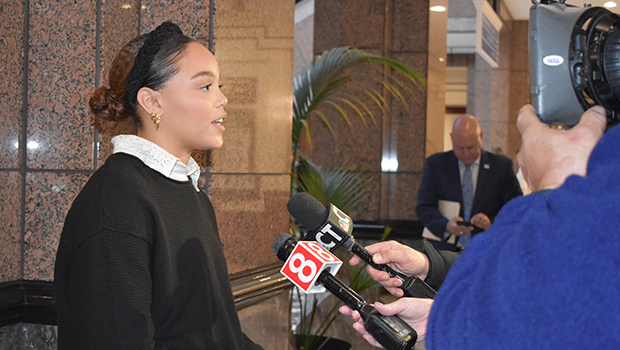
 Olivia DeLoach (pictured at top), a senior at Mitchell College who is student teaching seventh grade in Waterford, identified a series of costs associated with becoming a certified teacher—from unpaid student teaching to student loan debt and Praxis exams—against a starting salary that, she said, “brings up the hard question: How am I going to afford the things I need?”
“We are working on fixing educators’ pay so that our teachers are making a living wage and are respected for the contributions they add to our communities and entire society,” said Rep. Jennifer Leeper. “We also recognize the contributions and sacrifices they made educating our children during the pandemic while trying to facilitate learning at home for their own kids. It was a Herculean effort, and they deserve recognition for that. We know that supporting teachers is the most important thing we can do to support our children.”
Support comes in many forms
Bloomfield Education Association President Gail Jorden, who teaches fifth grade, said, “The minimum wage being proposed is a huge step in the right direction. In order for us to be competitive, we need to step it up and make sure we show teachers that they are valuable and that the work they do is respected.”
 Jorden also spoke to the importance of the COVID pension benefit and uninterrupted prep time. Few professions have to go to work and worry about being assaulted,” she said. “We need protections. We need to feel safe at work so that we can make sure our students are safe and that we can focus on educating them.”
Rep. Michelle Cook noted that the physical and emotional abuse many educators endure is a driver of today’s teacher shortage. “This is what we need to talk about when we talk about teacher recruitment and retention. Their safety should not be at risk to educate our children. Retaining teachers is about treating them with dignity and respect. It’s about listening to them and hearing what they have to say. When we talk about hero pay, I have to tell you, these are heroes.”
CEA Vice President Joslyn DeLancey also emphasized the need for teacher autonomy, better working conditions, and the restoration of meaningful pedagogy and play-based learning—all of which, she pointed out, have eroded under the burden of standardized testing.
 Rep. Christopher Poulos, a CEA member and 2007 Connecticut Teacher of the Year, said, “We need systemic change that brings teachers to the table, and this legislation provides a starting point for that shift.” He stressed the importance of having teacher representation on the State Board of Education so that the real-world implications on classroom practice are considered when new initiatives are discussed. “If we give teachers agency, we’ll make them proud again. We’ll make them want to stay in their profession.”
“I’m really excited to see us consulting with teachers, addressing what’s in these bills, and elevating teacher voice,” said Rep. Maryam Khan, adding, “One of the most important pieces is retaining teachers. We can recruit a lot of teachers, but if we’re not retaining them, we’re going to be here again.”
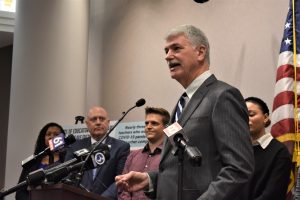 “The teaching profession is and has been under tremendous pressure,” said CEA Executive Director Donald Williams. “Someone with a bachelor’s degree or master’s degree can look at other jobs with better working conditions, a lot less stress, and a lot more money. All of us in the room can say, ‘It’s because of a teacher that I got a good education, that I was able to get a job that’s satisfying. We need to support that. It’s not every year in the legislative session that we have not only a crisis but the resources—the dollars—to deal with it. If we lift up this profession, then this will be a historic moment that will be remembered not just at the close of this legislative session but next year, five years, thirty years from now.”
Dias added, “It is time for our education systems to openly, clearly, and decisively stand behind those individuals who care for and teach our children. We can stop bleeding educators from our schools with bold and decisive actions that are supported by the vast majority of voters, 90% of whom say that teacher compensation should be comparable to or higher than professionals with similar education and training. It is time for us to make some history. We are in a time when needs and resources are aligned, when our desires for support and acknowledgment align with those of voters. The support is there; we just need this legislation to make it happen.”
Watch the press conference.