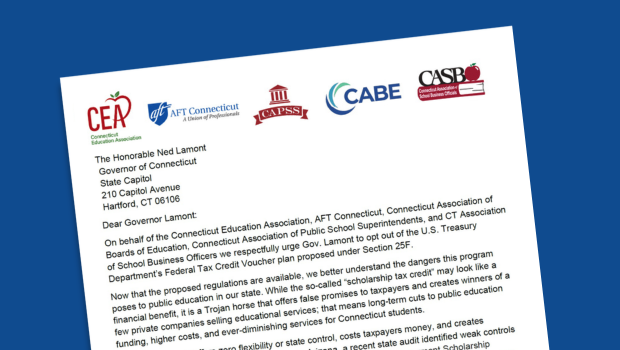
In a joint letter outlining their concerns about the Federal Scholarship Tax Credit, which has an opt-in deadline of December 31, key education stakeholders across the state are calling on Governor Ned Lamont to meet and discuss potential risks for Connecticut’s public schools and students.
In the absence of clear guidance over the past several months on how the tax credit would actually work—and in the face of mounting public concerns about how it would open the door to a private equity takeover of education services—governors in a number of states have postponed opting in.
The U.S. Treasury released temporary guidance on October 1.
“Now that the proposed regulations are available,” the joint letter reads, “we have a better understanding of the dangers this program poses to public education in our state. While the so-called ‘scholarship tax credit’ may look like a financial benefit, it is a Trojan horse that offers false promises to taxpayers and creates winners of a few private companies selling educational services; that means long-term cuts to public education funding, higher costs, and ever-diminishing services for Connecticut students.”
The letter, sent to the governor’s office yesterday, was signed by
- Connecticut Education Association (CEA) President Kate Dias
- American Federation of Teachers (AFT) Connecticut President Jan Hochadel
- Connecticut Association of Public School Superintendents (CAPSS) President Fran Rabinowitz
- Connecticut Association of Boards of Education (CABE) President Meg Scata
- Connecticut Association of School Business Officials (CASBO) Executive Director Sharon Bruce
The group is calling on Lamont to meet and discuss potential impacts and a plan to protect Connecticut’s public education system, currently ranked in the top three nationwide.
Pointing to millions of dollars in inappropriate spending in Arizona under a scheme similar to the federal voucher program, the letter warns, “This would dramatically change the landscape of public education and leave our state vulnerable to rampant fraud and abuse. We are concerned that the program would function primarily as a subsidy for private education…while offering no assurance that students with the greatest needs will be protected.”