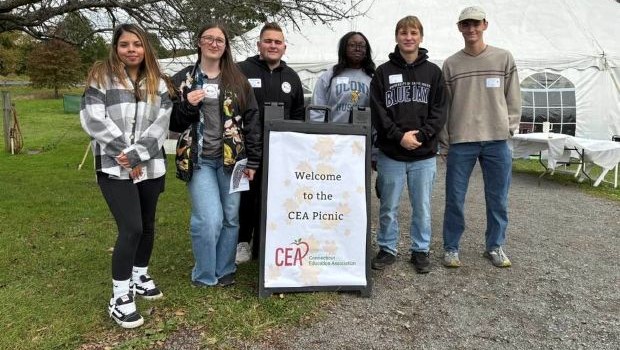
Despite the cold and windy day, this year’s kickoff event for the CEA Aspiring Educators Program had record attendance, drawing in 100 students from colleges and universities around the state. Held October 17 at Middlefield’s Lyman Orchards, the day brought students together for a corn maze, community bingo, CEA swag, lunch, a chance to learn more about CEA and the AEP, and opportunities to connect with their peers.
“It was so exciting to see a group of students energized and motivated to start their careers in education,” says CEA Vice President Joslyn DeLancey. “The CEA AEP is a place where new educators can find like-minded peers who support and encourage each other through their learning and certification journey. It was a privilege to welcome all of these new and passionate voices into our association.”
“The AEP kickoff is one of my favorite events,” says CEA Secretary Gail Jorden. “Getting to meet and spend time with future educators is always so fulfilling, and watching our AEP leaders run the event was incredibly motivating. Our future is bright!”
“Our team of state AEP leaders really ran the show, planning the event and speaking to attendees,” says CEA Educational Issues Specialist Elizabeth Sked, who serves as the CEA AEP statewide organizer. “Seeing the growth of our program and this event, I couldn’t be prouder of this team of leaders.”
 CEA AEP President and UConn master’s degree student Maia Schwing said the event was successful in attracting new members; 82% of the students who weren’t members joined on the spot.
“This is the third kickoff I’ve attended, and it’s steadily grown over those years,” said Schwing. “This year, many more people were open to asking questions and sharing why they love being a part of the program, which was very empowering to hear.”
Building community
CEA AEP EdRising liaison Midelys Colón, a student at Central, says she’s taken on a leadership role with the AEP to help build the community she herself found so essential as a new college student. As EdRising liaison, Colón works closely with high school students interested in careers in education to ease their transition to college and the AEP.
“When I first got to college, I felt incredibly lost,” she recalls. “I had been very involved in my high school, and not having that community in college was tough on me mentally and emotionally. Joining my AE chapter helped me find a space to connect. I tell other education majors, ‘You don’t have to do everything alone. There’s a space for you at your AE chapter, which is full of people who understand you and your goals.’”
“I encourage education majors to join their school’s AE chapter, because it’s so much more than an organization,” says CEA AEP Vice Chair Danyelix Echevarria Figueroa, an education major at UConn. “It’s a community of aspiring educators who share the same passion for education. It provides us with opportunities to build connections, develop leadership skills, advocate for our profession, and make a difference even before entering our own classrooms.”
 Schwing says AEP leaders intentionally design their annual kickoff event to help students connect socially. When they take on the corn maze, for example—always a popular activity—leaders ask AEs to form groups with people they don’t already know.
“A group might include someone from Southern, UConn, the University of Saint Joseph, and Mitchell,” Schwing says. “We try to help them build those relationships.”
That supportive community doesn’t end when students graduate into the teaching workforce. CEA and AEP leaders stress that their union will be there to assist future educators once they become classroom teachers.
At the kickoff, Jorden talked with a student who described her passion for education, the financial stress and family challenges she’s faced, and her dream of becoming a teacher.
“Conversations like these reinforce the work we are doing as a union and provide opportunities for me to share how our union can support her,” Jorden says.
DeLancey adds, “I can’t wait to see the work our AEs take on this year to support each other, fight for paid student teaching, and grow into the educators our Connecticut students and colleagues will be excited to learn from and work with.”
Annual membership in CEA’s Aspiring Educators Program is only $25, yet between student loans, unpaid student teaching requirements, and more, pre-service teachers often have tremendous financial responsibilities and few resources. You can sponsor an aspiring educator and ensure that your $25 gift supports a bright tomorrow for Connecticut’s public schools.