
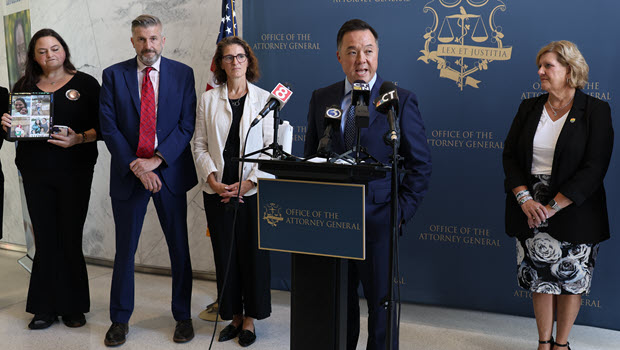
A news conference today organized by Attorney General William Tong at the State Office Building in Hartford began with the heartbreaking remarks of Tammy Rodriguez who lost her 11-year-old daughter to suicide in 2021.
“Selena was exposed to many social media harms that I had no idea were going on,” Rodriguez said. “I have become a big advocate who is very much into educating anyone in the life of a child of these harms, because they’re hidden and people need to know what’s really going on.”
Tong said that today’s landmark $17.1 billion multistate settlement with Meta Platforms, Inc. came out of action taken in response to the poor mental health and social media addictions inflicted by social media companies on children and teens around the country that have resulted in tragedies including Selena’s suicide.
“We’re here today because Connecticut and our country are taking a huge step forward to protect our kids by fundamentally transforming the social media industry in our country,” Tong said. “And we’re making Meta pay. We’re making Meta pay for its misconduct. And because of our action, because of our lawsuit, because of this coalition of 51 states, territories, and the District of Columbia, Meta will overhaul its platforms and the way it does business.”
“For a long time, we’ve lived in a space that has said, ‘Technology is just a part of life. This is the world our kids live in, and we have to train them to manage technology,'” CEA President Kate Dias told reporters. “What we have learned, and what this lawsuit proves concretely, is that our children, as individuals, cannot defend themselves from these multibillion-dollar, trillion-dollar corporations that seek to prey on them.”
The settlement will enforce sweeping new safety reforms to protect American children on Instagram and Facebook, resolving claims by 51 attorneys general that the company designed Instagram with addictive features, knowingly exposed young users to serious mental harms, and intentionally misled the public about the safety of its platforms, among other things.
Connecticut could receive up to $265.4 million over a 10-year period, with at least half of all funds directed to remediate youth harms from social media, including but not limited to support for mental health and crisis intervention, after school and summer school programming, and implementation of phone-free school zones. This is the largest state settlement with a single defendant in history.
The settlement requires Meta to implement a series of safety features on Instagram and Facebook, including:
- Hard cap daily time limits and “Productive Pauses” for children: for its two platforms, Instagram and Facebook, a combined two-hour daily time limit with mandatory pauses after 15 minutes of continuous use and again at 60 and 90 minutes to interrupt endless scrolling. These limits remain in effect for five years. If Snapchat, TikTok, and YouTube adopt comparable terms, the daily limit on each platform will drop to 60 minutes for 10 years.
- “Nighttime blocks” restricting children’s access from 12:00 a.m. to 6:00 a.m.
- Limited school-time access for children, eliminating push notifications on weekdays from 8:00 a.m. to 3:00 p.m. during the school year.
- Robust age assurance measures to more effectively verify the age of young users.
- Safer, age-appropriate content controls, including stronger safeguards against bullying, content promoting eating disorders, and content related to suicide and self-harm.
- Stronger, more user-friendly parental controls, including options to turn off algorithmic feed and auto-play.
- Limits on social comparison features, including beauty filters and visible “like” counts, that have been linked to poor mental health outcomes in kids and teens.
“The idea that maybe, just maybe, our children can get through the school day without being interrupted by notifications is a tremendous relief to us,” Dias said. “We were very close to phone-free schools during the last legislative session, and we will be back with that to the legislature this year.”
“Social media is all too often anti-social,” said Governor Ned Lamont. “Tech companies have increasingly been taking advantage of kids, creating apps and algorithms that decrease their attention spans, drive them to become addicted, cause them to tune out real life, and harmfully impact their mental health and wellbeing. This multistate settlement is long overdue and requires strong protections for children’s online safety. Connecticut has been taking steps to lead this charge, including through legislation that I was proud to sign into law this summer, but the best and strongest protections need to be enacted on a nationwide level.”