

Since 2021, the Stamford Education Association has been battling back against high school schedules that shortchange educators and students.
Last night—after five years of nonstop organizing and advocacy—they prevailed.
“We’ve had four different schedules in the last five years, all of them imposed by administrators with no input from teachers and no research to back them up,” said SEA President John Corcoran. “Each time, we pushed back. Each time, we explained how the schedule would negatively impact educators and students, and while it often felt like an uphill battle, we never stopped pushing.”
That push paid off. At a special meeting January 7, the Stamford Board of Education—which includes several newly sworn-in members—voted overwhelmingly, and in a bipartisan manner, to abandon the widely controversial schedule currently in place and restore the A/B eight-period schedule educators have been calling for. The A/B schedule, which resumes in the 2026-2027 school year, will have students alternate between eight classes every other day.
“Truly grateful to the community for their emails and calls to help achieve this result for our kids. It started on election night. Our voices were heard, and it was beautiful to see kids put ahead of politics.”
“Thank you for leading the charge [SEA].”
“Amazing! Elections have consequences.”
Those were a few of the hundreds of reactions Stamford community members had to the pivotal change.
Time’s up
Over the last five years, Stamford administrators repeatedly moved to increase high school teachers’ course load from five to six classes, cram yearlong classes into a single semester or semester-long classes into 45 days, and more. Each proposal would leave teachers with less time to adequately prepare effective lesson plans, grade students’ work, provide individualized attention to students, and work with their departments. Similarly, students would have fewer class options and no time between classes or days to absorb new information, ask questions, or get help.

Stamford resident and CEA Vice President Joslyn DeLancey (pictured with her dog, Nash) turned out and spoke up at numerous rallies and meetings aimed at restoring high schools’ A/B schedule.
“This was a ridiculously accelerated pace of curriculum delivery with unrealistic expectations for mastery of content, and lack of continuity in course offerings such as math and science that would surely result in learning gaps,” says Corcoran. “Students were falling behind, and teachers were finding it impossible to make the necessary adjustments and complete the curriculum in such a compressed time. They were busy re-teaching. You can’t skip decimals. You can’t skip fractions. What do you do?”
He adds, “One of our three high schools, the Academy of Information Technology and Engineering, had been operating on an A/B schedule since 2000. It was a model for the state and a big part of the reason AITE was ranked among Connecticut’s top ten high schools. Now we were abandoning a proven schedule for ones where the data didn’t support student success. We kept asking, are we willing to throw away what we know is right for kids?”
Educators held rallies and walk-ins protesting “Six Is Not the Fix” and “Shut the Door on the 4×4,” two schedules that were negatively impacting teaching and learning.
“With teacher shortages continuing to plague the state, Stamford kept trying to pile on additional work for educators already stretched thin, giving them even more reason to leave the profession or go to a nearby district with a reasonable schedule and higher pay,” said CEA President Kate Dias.
One of those neighboring districts—Darien—is where Stamford resident and CEA Vice President Joslyn Delancey is a veteran teacher. DeLancey regularly attended and spoke at Stamford rallies, town meetings, and more.
“These are not adversarial actions,” she said of SEA’s protests and organizing efforts. “They’re an act of love and dedication to the students and families of Stamford. Protesters have been speaking about an issue they are deeply concerned about, and they are not being heard. I work for a thriving public school system right next door. We’re not going with this schedule; we’re not even thinking about it.”
Groundswell of resistance
CEA UniServ Rep Sharon Milano worked closely with SEA and CEA leaders to keep the pressure on to fix the problematic schedule.
“We took every opportunity, big and small, to get our message out and get decision-makers and community members informed and on board,” she said.
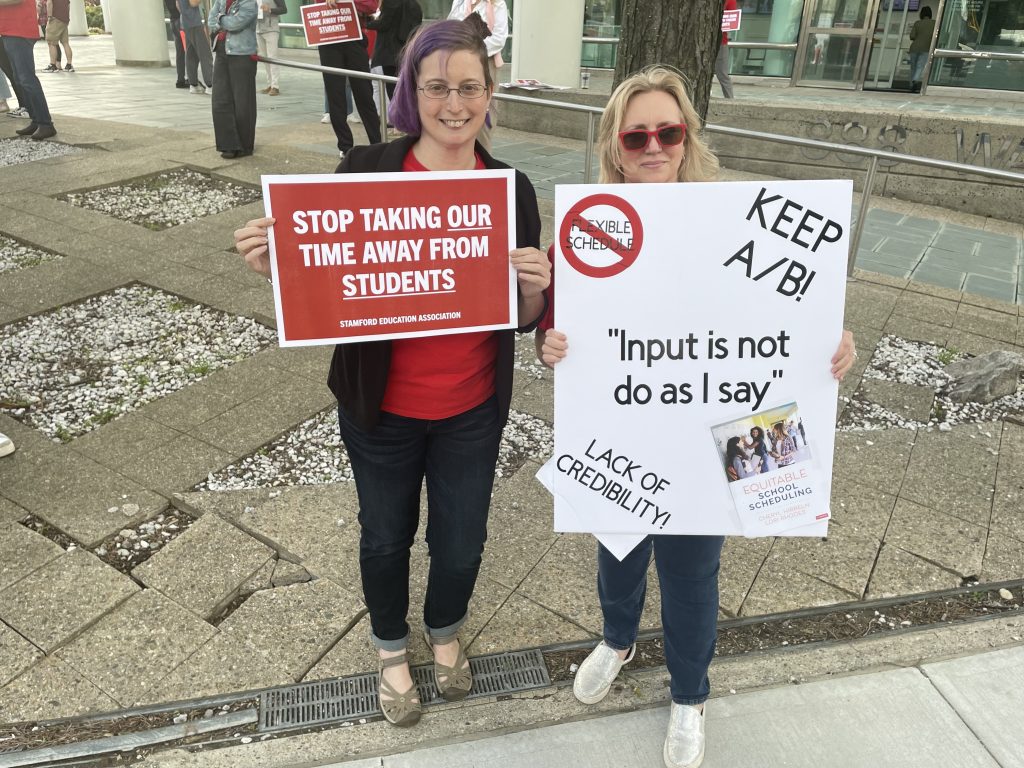
Stamford educators and parents stand side by side in support of a better schedule for students.
That included meeting with the mayor, rallying at the mayor’s State of the City address, marching and protesting, posting to social media to raise community awareness, conducting school walk-ins, carrying signs outside town meetings, attending and speaking at public meetings, and hosting open houses and forums where any parent or community member could come and learn about the school schedules.
There were occasions when SEA had little time to plan, but even when time was tight, they found opportunities to make a difference.
“A local TV news reporter was at one of our smaller events,” Milano recalls, “and we informed the reporter about why we were gathered. That reporter began following our efforts and reporting on the opposition to the schedule. At public meetings we met influential parents from the community, and we established relationships with them. They helped coordinate greater parent participation and voice so that the BOE would hear from parents in person, through phone calls and emails, and on social media.”
SEA also formed a political action committee, led by SEA VP of High Schools Michelle Pusser with support from CEA Political Engagement Coordinator Gus Melita. Candidates running for BOE and mayor were surveyed on their positions, and their responses were used to develop a candidate report card that was made public.
Talks continue
November’s elections welcomed several education allies to Stamford’s BOE, and SEA met with them to ensure they understood the issues facing the district, especially problems with the high school schedule. After they were seated on the BOE, Corcoran continued having regular conversations with them, often to clarify or refute misinformation administrators gave about supposed “successes” and “benefits” of a 4×4 schedule and to explain exactly how the A/B schedule better serves students and teachers.
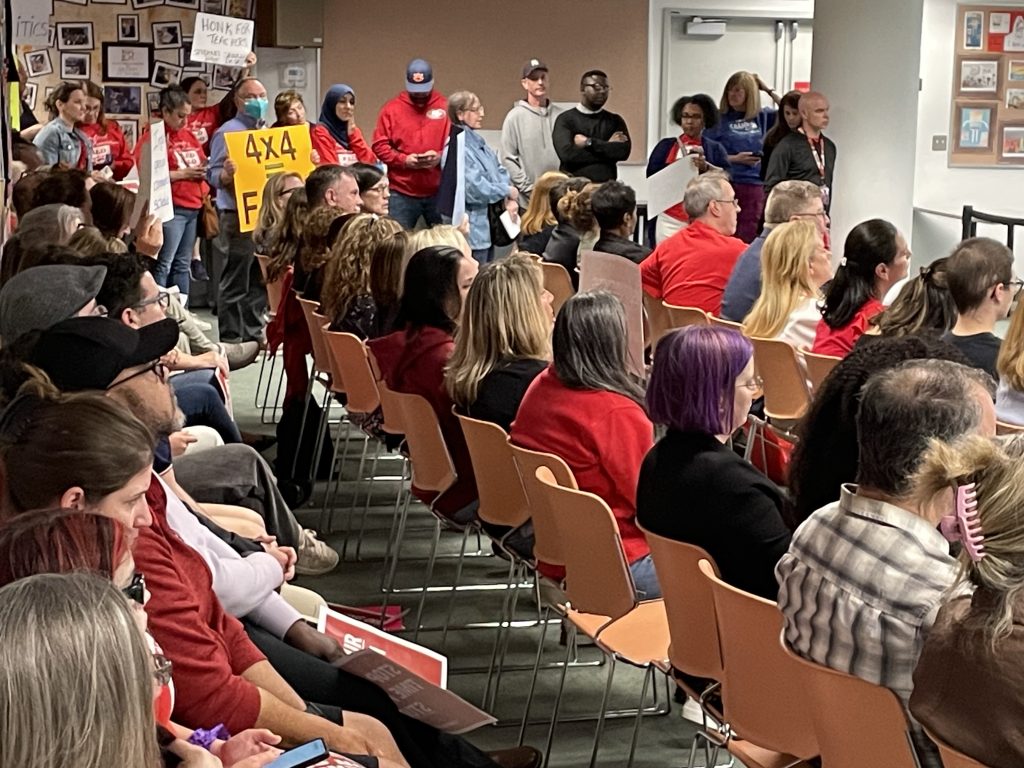
A groundswell of resistance led to important changes to the Stamford Board of Education and the district’s schedule.
“Throughout all of this, we kept the pressure on the Board and Central Office by regularly submitting op-eds and letters to the editor,” Corcoran notes. “On Jan 5, the first day back from our holiday break, the SEA held another open house and met with community leaders. We knew the BOE was holding a special meeting two days later to discuss repealing and replacing the controversial schedule, so we urged parents and educators to continue talking to board members about their experience with the high school schedule.”
The BOE received an estimated 100 letters.
On January 7, they voted 8:1 to replace the 4×4 schedule with the A/B eight-period schedule, where educators teach five of the eight classes.
“The new board trusts educators, and its members consult with us,” Corcoran says. “In the two months since they were elected, they’ve gone out to our schools and talked face to face with school counselors, students, teachers, parents, and schedule developers. We have gotten more done with the new board in the last month than we had with previous boards in years, and that’s exciting. This is what can happen when we work together and persist. We need those good relationships and the ability to discuss challenges, talk about solutions, and bounce ideas off each other. I’m proud of my colleagues and educators all around our state fighting similar battles. It can seem like you’re never going to win, like you’re outnumbered or outranked, but educators standing together are a powerhouse. We did it.”
Watch for more union wins like Stamford’s in the next issue of the CEA Advisor.