This month marks the 25th anniversary of 9/11. Connecticut teachers are ensuring today’s students understand what that day and its aftermath were like, and many are doing so by sharing their own and others’ personal stories with their classes.
Danbury social studies teacher Heather Lorenz is one of the many educators who has chosen to focus her lessons around those who stepped up to help during that difficult time. A colleague of hers, Christine Riter, came up with the idea to have students read about how the community of Gander, Newfoundland, and other communities in that region of Canada, volunteered to help as many international flights headed to the northeastern United States on 9/11 were rerouted there.
“I decided to adopt this lesson because I wanted to focus on the positive actions coming out of this horrific day,” Lorenz says. “The residents of Gander, and the surrounding communities, along with other locations, such as St. John’s, opened their homes, schools, community centers, and buildings to find spaces for all of the stranded travelers. They made and provided food for all of these people and shared what they had available to help perfect strangers.”
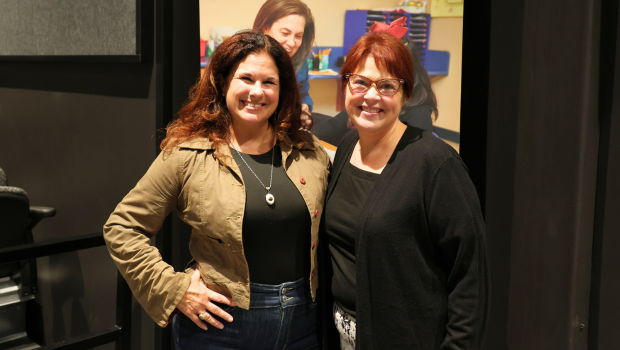
Lorenz’s friend Kristen Hallett Rzasa was one of those passengers who were stranded in Newfoundland on 9/11, and Lorenz thought Rzasa’s story would be a direct extension to the lesson, so she invited Rzasa to speak to her capstone class at Danbury High School’s West Campus. The capstone is a civics project-based class that allows students to explore social issues in Danbury and the rest of the country.
“The stories of what Kristen and the passengers experienced tie in directly to what we are teaching about in the capstone class—in essence, do something to make the world a better place,” Lorenz says.
Kristen Rzasa’s story
Rzasa, who worked for DaimlerChrysler Financial Services at the time, was on a business trip to Germany in early September 2001. At the end of her trip, she met up with her boyfriend in Paris and they stayed up late the night of September 10 enjoying their time in a foreign country, before boarding a plane to JFK in the early hours of September 11.
The plane had been in the air for five hours when Rzasa got up to use the restroom. The pilot came out of the cockpit and told her, “We have a change of plans.”
Not long after, an announcement came over the loudspeakers, and passengers were told the plane would need to make an emergency landing because there had been an incident in New York.
“Most of the people on the plane lived in or near New York,” Rzasa says. “People started to get worried. Many people didn’t have cell phones at the time, but people who did have phones started trying to call friends and family. Most of them were not getting through. Somehow I got through. I couldn’t reach my mother in Ridgefield or my brother who commuted to work walking through the World Trade Center. I finally got through to my grandmother, and she said, ‘Kris, the World Trade Center Towers have fallen down and so has the Pentagon.'”
Rzasa initially thought the news couldn’t be true, but then other passengers on the plane were able to reach friends and family who told them a plane had crashed into the towers.
“The most vivid moment that stands out to me is when someone on the plane shouted, ‘They’re shooting planes every ten minutes!’ We didn’t know the truth at that moment and total chaos and panic ensued.”
Give help when you can
Because she’d successfully been able to get through to loved ones on her phone, other passengers started lining up to use Rzasa’s phone.
“It was a lesson on giving help when you can. It was very nerve wracking for me. Lots of passengers lived, worked, or had family who lived or worked in New York City. I didn’t know if they were about to get the worst news of their live. I was holding my breath each time someone made a call. Most people didn’t get through though.”
Eventually Rzasa’s plane and 27 other international flights were rerouted and landed in St. John’s, Newfoundland. Many other planes landed at other airports in the region.
“No one knew what was going on; we had to sit there and wait. The airline staff couldn’t tell us much because they themselves didn’t know much. They gave out the rest of the food and drinks that were on the plane. Planes aren’t stocked for people to live on them for an extended period of time, so we quickly ran out of things like toilet paper. We finally got off the plane around 2am on Wednesday the 12th. We’d spent around 32 hours on the plane all together.”
Both the United States and Canada closed their airspace, the only time in history that that has happened.
Reflecting on a difficult time
Students had many questions for Rzasa. “What did you do on the plane for 30+ hours?” one asked.
“Mostly I sat and stressed and talked to my boyfriend about how we were going to get out of there,” she said.
“Were there babies on the plane?” another student asked. Rzasa responded that there were, and that there weren’t enough diapers for them. There was also a lack of sanitary products for women, something she herself needed at the time.
When they finally disembarked, the passengers passed rows of soldiers lined up holding their weapons.
“They didn’t know who was on the plane and everyone was nervous at the time. We were told we could only take our passports and a small purse. We had to leave our carry-ons and all our checked luggage on the plane.”
There were nowhere near enough hotel rooms in the area for all the passengers who had been rerouted, so the people on Rzasa’s flight were first taken to a hockey rink. At 2:00 a.m. the stadium called in staff who usually worked concessions to open the snack stands. The Canadian Red Cross and Salvation Army set up tables to provide baby formula, diapers, sanitary products, pet food, and other necessities.
“Many people on these international flights did not speak English or other languages commonly spoken in the U.S. and Canada,” Rzasa said. “There was no one to explain to them what was going on. Messages kept coming over the loudspeakers asking if anyone knew Mandarin, Arabic—a variety of different languages—in order to help translate and explain what was going on. There was no Google Translate back then, no smart phones. If you have a gift, it’s great to be of service.”
Passengers were then grouped by flight and taken to a variety of locations including area schools. Five hundred people, including the passengers on Rzasa’s flight, were taken to HMCS Cabot, a Canadian Forces Naval Reserve Division base. Neighbors made food for the passengers and the Red Cross brought sandwiches.
“When we got to the naval base, it was the first time we’d seen the news. It was a shock watching what had happened. By the time we got to the naval base, I had finally learned that my brother was safe. He had walked through the Towers 15 minutes before the first plane hit. He had to walk from Manhattan to New Jersey covered in soot and with debris falling from the sky.”
While Rzasa found it impossible to sleep in a room with 200 people lined up in sleeping bags and given the uncertainty she was facing, she felt fortunate that, due to her employer’s assistance, she had access to a car.
“We’d been in the same clothes for 3-4 days,” she said. “We were able to drive people to Walmart. I bought a second outfit, but I didn’t want too many things because we had to carry all our possessions around with us. We didn’t want to be gone too long from the naval base, because there were no texts from the airline at the time. The only way to know what was going on was to be there when an announcement was made.”
Heading home
On Sunday, Rzasa’s flight was finally called for departure.
“It was pretty much chaos at the airport,” she said. “We all had to go through tight security. They were pulling out anyone who looked suspicious. There was definitely a lot of profiling going on.”
She added, “When the pilot announced we’d crossed into U.S. airspace everyone cheered.”
Unfortunately, the plane, originally bound for JFK, landed in Columbus, Ohio, because New York area airports were still closed.
Rzasa says that people were enraged, but that it could have been much worse. She was on a U.S.-based carrier, Delta, so her flight did return to the U.S. Many international carriers flew their planes back to their home countries, leaving U.S. residents who had booked on those airlines with a much longer and more complicated voyage back home.
Working for a car company again came in handy for Rzasa as her employer provided a car she could use to drive the 600 miles back home.
“I got on a plane early Tuesday morning and arrived home late Sunday night. It was six days of very little sleep.”
Lessons from that day
Rzasa said the experience brought home to her and many others the importance of living their truth and values.
Four months after the attacks, DaimlerChrysler unmerged and Rzasa lost her job. “I had loved my job, but I really wanted to have my own business and be my own boss. I think the events of that day made a lot of people really reconsider their lives. ‘Am I in a relationship, job, etc. that really fulfills me?’ It was a reckoning period for a lot of people. I had thought, ‘I should climb the corporate ladder,’ but I realized that’s not what I really wanted.”
Many years later, in 2017, the musical Come from Away debuted, sharing the story of passengers like Rzasa who spent a week in Canada after their flights were rerouted on 9/11.
“I went with my mom to Broadway to see it,” Rzasa says. “I sobbed the entire time the first time I saw the musical. It was a cathartic situation to have what I experienced acknowledged. I could never explain it to someone as well as that musical could.”
Rzasa says she struggled in the period after 9/11, feeling lucky that she was safe and was able to go home while knowing the same wasn’t the case for so many other people.
“People had horrific experiences, so I tended to discount what I went through and minimized it,” she said.
When she did talk to a therapist about her experiences on 9/11 they told her she didn’t need to compare her experiences and emotions to anyone else’s.
“If I need support, that’s valid. I didn’t need to have had debris fall on me to have had an experience I need to process. Every experience counts.”
Rzasa recommended the Danbury students watch the musical, which is available for streaming on Apple TV.
“The musical is so uplifting. The people in Canada gave us so much. Some people opened their homes to strangers, made us food, donated clothing. They were very giving. The musical is about the nature of kindness in the face of tragedy.”
She adds, “For a day so horrific for so many, there are an equal number of stories of people coming out and supporting one another. I never want to relive September 11, but I wish I could go back to September 12. We were so unified.”