Recognizing that up-to-date, transparent funding systems are critical to Connecticut’s public schools, Governor Ned Lamont signed an executive order yesterday establishing the Blue-Ribbon Commission on Education Funding and Accountability. The commission will examine special education and other cost drivers impacting schools, review current funding systems, and make recommendations by December 31, 2026, for improving the ECS formula, Alliance District Program, Excess Cost Grant, Special Education Development Grants, and more.
Closing the gap
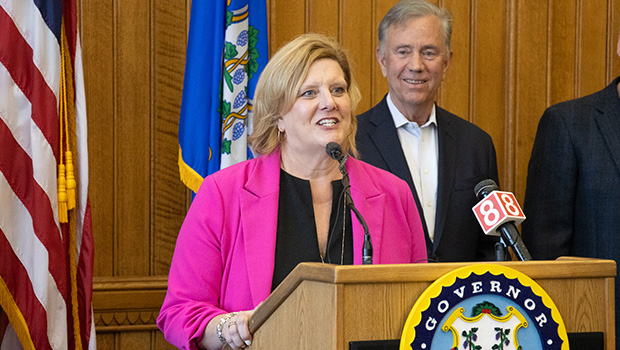
“Connecticut is sixth in the country in per pupil spending, which indicates we have a strong public commitment to making sure our students get what they want and what they need,” said CEA President Kate Dias, who was appointed to serve on the commission. “However, we are 43rd for the state’s contribution, and that’s where we run into the problem we’re having today. The difference in funding is being made up at the municipal level, which creates incredible disparity of experience.”
Comparing socioeconomically diverse communities such as Hamden with affluent suburbs like Darien, where the average home value is at least seven times higher, Dias noted that while some communities have no problem making up the education funding difference, others struggle to close the gap.
“For me, this commission is an opportunity to correct that imbalance and decide what we want for every child in Connecticut,” she said. “If you ever want to know what someone values, all you have to do is look at their checkbook. We’re looking at our checkbook and deciding what we value. Teachers are ready and willing for this challenge. They’re excited to be part of the conversation about evolving public education, and I’m excited to help Connecticut make a strong statement about our values.”
The work begins
“This won’t be easy, but it will be incredibly impactful,” said Lt. Governor Susan Bysiewicz, echoing that while Connecticut ranks third in the nation for the quality of its public schools, “Our progress hasn’t been equal across all of our districts or for all of our students. We owe the same opportunity to every child in our state. Our education funding formulas were designed decades ago and may have served a purpose at the time, but they clearly don’t reflect the realities of our classrooms right now and the growing needs of our communities.”
“I think we’re going to be able to make a substantial investment in K-12 education this legislative session and make sure it’s sustainable,” the governor said, pointing to the state’s $500 million affordability fund as one source of additional dollars. He added, “This commission is going to figure out the best funding formula for the foreseeable future and how we can make sure the money makes the biggest difference in our kids’ lives.”
It’s not about us without us
The newly formed commission includes teachers, representatives of boards of education, town government, district administrators, state agencies, the legislature, state and national education funding experts, special education directors, regional education service centers, alliance districts, and parents. Heading up the group is the governor’s Deputy Chief of Staff Natalie Wagner, with Education Commissioner Charlene Russell-Tucker as vice chair.
“The governor is bringing us all together to work on these challenges because having a wide variety of stakeholders at the table is necessary to understand where the most significant problems are and prioritize those where we can identify practical solutions that have the most impact,” Wagner said. “There are few areas where it is more important to do that work than public education.”
The commission will meet throughout the year and provide opportunities for additional stakeholder feedback through regional in-person and virtual listening sessions. Subscribe to the CEA Daily for more education updates and opportunities to make your voice heard as the commission begins its work.