
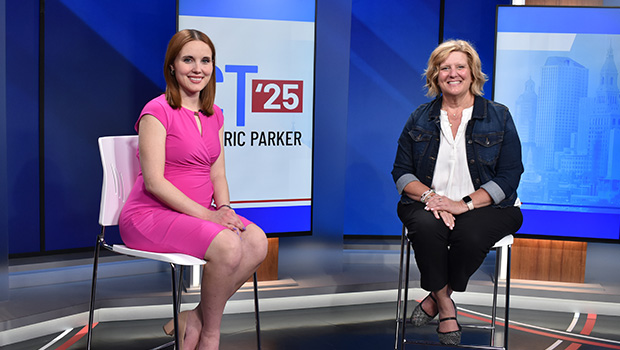
With the first of Connecticut’s public schools welcoming students back to class on August 21, CEA President Kate Dias sat down with WFSB reporter Cassidy Williams to talk about changes anticipated under the current presidential administration and concerns about how Connecticut schools might be affected.
“There are a lot of things you must be watching this coming school year,” Williams noted, asking what tops the list.
Watch list
“I think the smartest thing to pay attention to is budgets,” said Dias, “because one of the most significant impacts of the federal shift is going to be how municipalities manage their budgets. If I were to give one piece of advice to families, it would be to tune in to what your local boards of education are talking about. Are there cuts they’re considering—things that you, as a parent, may want to advocate to maintain, such as mental health services, after-school programs, sports—things that could potentially be cut if we see widescale federal cuts come into play.”
She continued, “Connecticut fought off the first round of cuts through activism, legislation, and the legal efforts of our attorney general, but we know there’s more coming.”
Early signs
Dias noted that some towns have already started to see programs being scaled back as a precautionary measure, with cutbacks in staffing, a pause on hiring additional educators and social workers, and districts weighing whether or not they will be able to continue offering before- and after-school programs.
“Where they would normally add positions or fill them due to attrition,” she said, “we’re seeing superintendents being very cautious and asking, ‘If we push our class sizes a little higher, can we hold off on hiring someone?’ It’s really critical for us as families and communities to pay attention to how those decisions are made and what the long-term impacts are. Increasing class size has a strong impact on student achievement. I’ve taught in a classroom of 12 and a classroom of 30, and there are so many differences. Let’s start with proximity. It’s very difficult to physically get to a student in a class of 30 children densely packed into a classroom. As a high school teacher with a 45-minute class period, you’re getting less than a minute to engage with any given student. And the ability to collaborate, have conversations, and build community that we place such a high value on—it all becomes harder to do effectively. You’re having to rebalance resources.”
When asked about this year’s incoming kindergarten class of “COVID babies”—those born at the height of the pandemic—Dias explained that the intervening years shown us a lot about the need for social and emotional connection.
“It’s one of the reasons we emphasize play-based learning and community-building in schools,” she said, adding, “It’s especially crucial for children who may have been isolated in their formative years. Our classrooms are where we help them connect and communicate with each other. A lot of the skills necessary for kindergartners are best taught through play, and we see the benefits all the way through twelfth grade.”
Referencing CEA-backed legislation that made play-based learning mandatory in the earliest grades beginning in the 2024-2025 school year, Williams asked about CEA’s biggest legislative achievements in the most recent legislative session.
“Some of the biggest emphasis was on special education,” said Dias. “A committee really dug in and looked into what we can do to support our special education students. A lot of work was done to develop programs and figure out how to keep as many students as possible in their home district schools, creating additional interventions. Parents of special education students should be keying in and having conversations about how their child’s school is working with the new law and what opportunities are there to build out the continuum of services to get the best for their children.”
What’s at risk
The potential for federal cuts in special education funding is particularly worrisome, Dias added. Because legal mandates govern special education services, those services must be provided according to a child’s IEP, regardless of whether or not funding exists.
“So if federal dollars are scaled back, districts are going to have to make up that money somewhere,” she explained. “They may do that by cutting back on other services, such as counseling. They may cut down on programs to address other issues, such as school attendance, or food, or housing. We have to remember that schools are centers of our communities with outreach into a lot of different spaces. When we start cutting funding, we’re cutting off opportunities for our children.”
Watch the full interview this coming Sunday, August 3, at 8:30 a.m. on WFSB Channel 3.