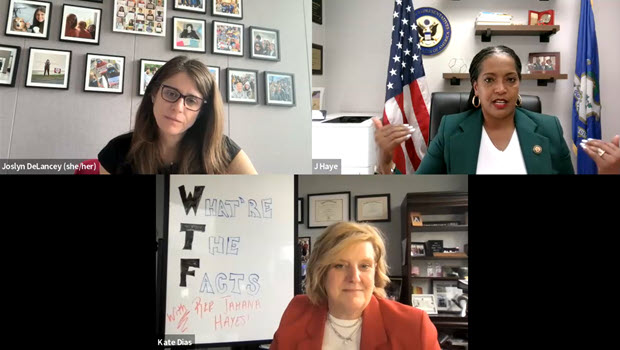
Amid the confusion and obfuscation coming out of Washington, D.C., it can be tough to know what’s really going on and where to focus our efforts. That’s why CEA is holding biweekly What’re The Facts webinars for members. On this week’s webinar, CEA President Kate Dias and Vice President Joslyn DeLancey were joined by Congresswoman Jahana Hayes so members could hear the latest directly from a federal elected official.
“Facts matter, facts are so important right now,” Hayes said. “It’s so important to have teacher voices in Congress. There are so many people having conversations about this profession, around this profession, and on behalf of this profession who really don’t have a true understanding or idea about what actually happens.”
She added, “Many of my colleagues say, ‘We support teachers’—my response is always, ‘Prove it.’ Supporting teachers is not putting a sign in your window or putting out a rallying call. It is making sure they have the resources they need to provide the best possible outcomes to the kids who are entrusted to them. You can’t have it both ways. You can’t talk about your support for teachers and public education and support the work that they do without putting the infrastructure in place to make that work possible. I’m just at a point where I’m unrelenting, unapologetic, unforgiving, intolerable of this idea that students’ futures are being played with as political pawns.”
She said that, despite the overwhelming amount of negative news, she does see public sentiment starting to turn the tide.
“I see my colleagues running scared because they make these blanket declarations: ‘We need to eliminate the Department of Education.’ But then when people locally start asking specifically about the programs at their school, elected officials are walking it back and talking in circles. When members of the public show up and ask those questions and amplify conversations so that they gain traction, people are saying, ‘Oh, wait a minute. I didn’t know you were talking about my school.’ We’re talking about everybody’s school.”
Public sentiment came out strongly against recent comments by Health and Human Services Secretary Robert F. Kennedy Jr. that disparaged individuals with autism.
Dias said, “Shout out to our special education teachers. They were really appalled and were the first to respond and comment about the narrative he put forth about individuals with autism, the absolute lunacy of the comments, and the complete lack of regard for the humans we’re talking about.”
“I remember in elementary school when special education classes were in the basement,” Hayes said. “For him to make a comment saying, ‘You never see these kids.’ We work so hard to get those kids out of the basement. As someone who worked at the Southbury Training School for over a decade, I recognize that there are many people who were institutionalized as children who, with proper interventions, could have led a full and productive life in the community, but they became institutionalized because they lived in these facilities. So, for a secretary of Health and Human Services to even make comments as if we were better off when we were not meeting the needs of these students and just tucking them away is so incredibly irresponsible and offensive.”
She continued, “I have so many friends, some probably on this call, who chose special education as a career pathway because they believe in those kids and they know that with the right person and the right environment, they can reach their full potential. Those were fighting words. I was so angry.”
How can educators make a difference?
Staying engaged is incredibly important, Hayes said, as is educating ourselves so that we can share accurate information with friends, family, and colleagues.
“Not in a political, legislative, or policy fashion, but just, ‘This is what that means,’ or ‘This is how my child benefited,’ Hayes said. “People are better at standing up for their friends than they are at standing up for the concept of a public good.”
While so much focus is currently on the federal government, Hayes said that holding local leaders accountable is more important than ever.
“When I can see my school districts are holding together and protecting diversity, equity, and inclusion, and municipal leaders are saying ‘We are going to protect our undocumented students because they are entitled to a safe public education,’ it makes it easier for me at the federal level.”
She added, “And when we have leaders that are not holding up their end of the bargain, people need to hold them accountable and not reelect them because that becomes a bellwether at the federal level. Even though the first opportunity to make any dent in the federal balance of power is in November of 2026, it is not lost on my Republican colleagues when they see their Republican mayors and first selectmen losing elections. They use those as inflection points, and they’re seeing what’s happening around the country. So, when you see these state legislature seats flipping, when you see local elections or judgeships flipping, they’re paying attention to that and really testing the temperature.”
Set the temperature, don’t measure it
“We have to make the conscious decision to stop being a thermometer and taking the temperature and switch to being the thermostat and setting the temperature,” Hayes said. “We must keep the heat on and make sure people are held accountable, make sure people are engaged.”
Dias noted that this winter and spring CEA has been encouraging members to speak up at board of education and other town meetings to make sure their voices are heard where they can be, at the local level.
“We want local officials to know we are present, we are participating, and we’re holding these individuals accountable,” she said.
Dias, DeLancey, and several other CEA members spoke at a hearing on a special education bill Monday, and Dias emphasized how important it is for lawmakers to see teachers’ faces and hear their stories.
“We need to be in that space, reminding people that these are not abstract concepts. These are children,” Dias said. “The power of public pressure is about keeping the dialogue ongoing, keeping the questions in the room, and sharing what is it we are worried about and what we value.”
“Not everybody’s going to run for leadership in the union or for any elected position, but everybody can do something,” Hayes said. “Talk to your neighbor, write a letter to the editor, or amplify your own personal story—and not just at board of education meetings. We bleed into everything—whether it’s planning and zoning commissions or town councils when they’re deciding how money is going to be spent.”
She continued, “We’ve been thriving here in Connecticut, and now at every meeting that I have, every community is trying to decide how to spend that $4 billion state budget surplus. Some tough decisions are going to have to be made, and if we want our children and our educators to be at the forefront of those decisions, then it can’t just be CEA or elected officials speaking up. It’s got to be everybody who has skin in the game saying, ‘Our budgets reflect our priorities, and our priority is our children.'”