
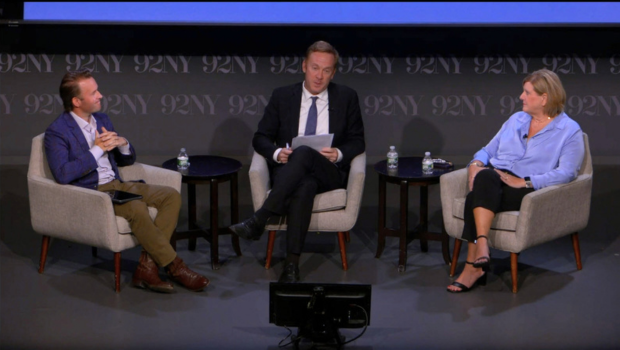
Supporting students means supporting the professionals who teach and care for them. That’s the case that CEA President Kate Dias made during a Dialogue Project conversation titled Are teachers’ Unions Good for Kids? hosted by 92NY’s Belfer Center for Innovation & Social Impact last night in New York City.
The debate, moderated by Jonathan Lemire, co-host of MS NOW’s Morning Joe and a staff writer at The Atlantic, featured Dias and American Federation for Children CEO Tommy Schultz and showcased two sharply different perspectives on teachers’ unions, school choice, accountability, and the future of public education.
“Teachers’ working conditions and students’ learning conditions are not separate things, so when we talk about the issues that teachers are concerned about, those are the things our children need,” Dias said. “We can talk about salary and benefits, but ultimately having qualified educators that are consistently in the classroom is good for kids. The investments that educators look to make are about building community, honoring children and ensuring that the broad spectrum of student needs are met.”
Power in community
Dias said that she didn’t know much about unions when she first became a member, but that she found in her union the same commitment to community and power in collective action that she had experienced from her family’s involvement with the PTA involvement, their church, and local politics.
“When you involve yourself in your local community, you can be part of building, growing, and creating opportunity for others,” Dias said. “The union for me is about that kind of community. As a member, I looked to my union to help me solve problems for my students. I wish I could have gone to a department head to say, ‘I need this,’ but often the resources were not available. In order to make sure that town and school community understood what we needed, I needed to be more than one voice shouting into the wind. I had to be a member of a community of educators that could come together and elevate a position to make it known and understood.”
Decision making
Dias explained that often, the decisions superintendents and boards of education make run contrary to what teachers think is best for their students. Despite educators’ best efforts, superintendents and other administrators, board of education members, and other decisionmakers often choose curricula and policies that are not in the best interests of kids.
Shultz said that, although Dias had described superintendents as the ones making poor decisions, “It’s not as if teachers’ union officials aren’t talking to superintendents all day long, negotiating with them all day long—best friends in all sorts of ways.”
“Teachers’ unions and administrators are not the same thing. We are, in fact, separate entities who are often at odds with each other,” Dias said. “I wish that in the world that I live in superintendents were meeting with me for hours every day and acquiescing to my every demand. That is my dream, but it does not actually happen that way. More often than not, we as unions are fighting with our superintendents.”
Dias explained that in recent years in two Connecticut communities teachers’ unions came together with parents to drive out superintendents who were abusive to educators and families
“I don’t know where you’re getting the mythology that teachers and superintendents are standing arm in arm; that’s absolutely not my world,” she said.
School choice
Schultz advocated for school choice options for parents and said that vouchers should be available everywhere so that parents can choose the schools they think are best for their children.
“There’s no better decisionmaker than a parent to guide the educational destiny of their children versus a bureaucrat or a union member,” he said.
Dias pointed out that vouchers rarely cover the full cost of private school tuition, meaning that vouchers aren’t useful for families who can’t afford to cover the gap between the value of the voucher and the cost of attending a private school.
“It’s inequitable, and the promise that this is going to help the poorest of our children is a fallacy,” she said. “What we’ve seen with vouchers is that the money has just been diverting public money to people who were already sending their children to private schools. Somewhere between 60 and 90 percent, depending on the state, of voucher dollars are going to families whose children are already enrolled in private schools.”
Dias added that in states with voucher programs there has also been lots of fraud and misuse of voucher dollars.
“There have been more and more cases of people using them to buy televisions or go on vacations. There are two people in Oklahoma getting ready to be indicted for misuse of voucher money,” she said.
Teachers’ why
Dias pointed out that teachers’ unions are their teacher members, and that teachers choose their profession, not for the money, but because of their commitment to children.
“People who have chosen to go into education do so because they are committed to taking care of other people’s children at the core,” Dias said. “The only thing that drives you to be an educator is a passion for trying to build a better future for kids. It is often a really difficult job. It is fraught with a lot of barriers—some are financial, some are personal. There’s often pressure from politics that we didn’t invite pushing into classrooms. Why would somebody want to put themselves through that if they weren’t fully committed to helping kids?”
Some of the other topics the debated included the impact of teachers’ unions on student achievement, the role and influence of teacher’s unions in policy and politics, how decisions about educational resources should be made, and the impact of strikes and other labor actions on teachers, schools, families, and students.