
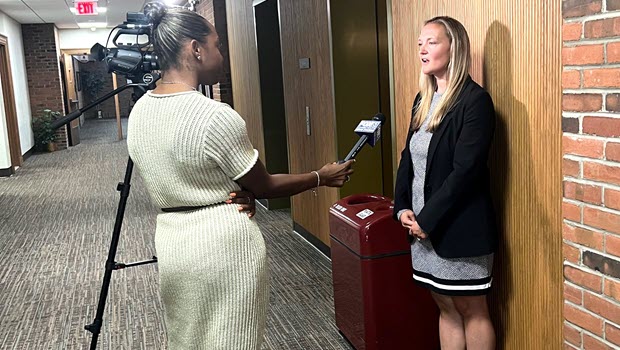
West Hartford teachers are heading to arbitration over a grievance about the consequences of special education staffing shortages after the Board of Education failed to address their concerns at a meeting last week.
West Hartford Education Association members who work in the district’s post-secondary special education program have been assigned longer workdays and given additional duties. Because of staffing shortages, they went without prep periods and lunch periods for approximately half the school year.
“We don’t have substitutes, so when there were absences, as well as unfilled positions, it was hard to follow what’s written in the contract without jeopardizing students’ needs,” post-secondary special education teacher Carla White (pictured above) told the Board.
White said the program started the 2024-25 school year with only 10 paraprofessionals, although students’ needs dictated that the program should have had 18. Due to the staffing shortage, White said she was unable to “develop a schedule where I could implement the student’s IEP goals and objectives as well as fit in contractual benefits such as lunch and prep time.”
The teachers reached out to the WHEA for help, but despite many months of conversations, the union and administration have not been able to come to a resolution.
CEA UniServ Rep Sara Pomponi represented WHEA members, arguing the case in front of the Board of Education at the level three grievance meeting last week. She maintained that special education teachers should be compensated for the additional hours they had to work due to their missed contractual breaks and prep periods.
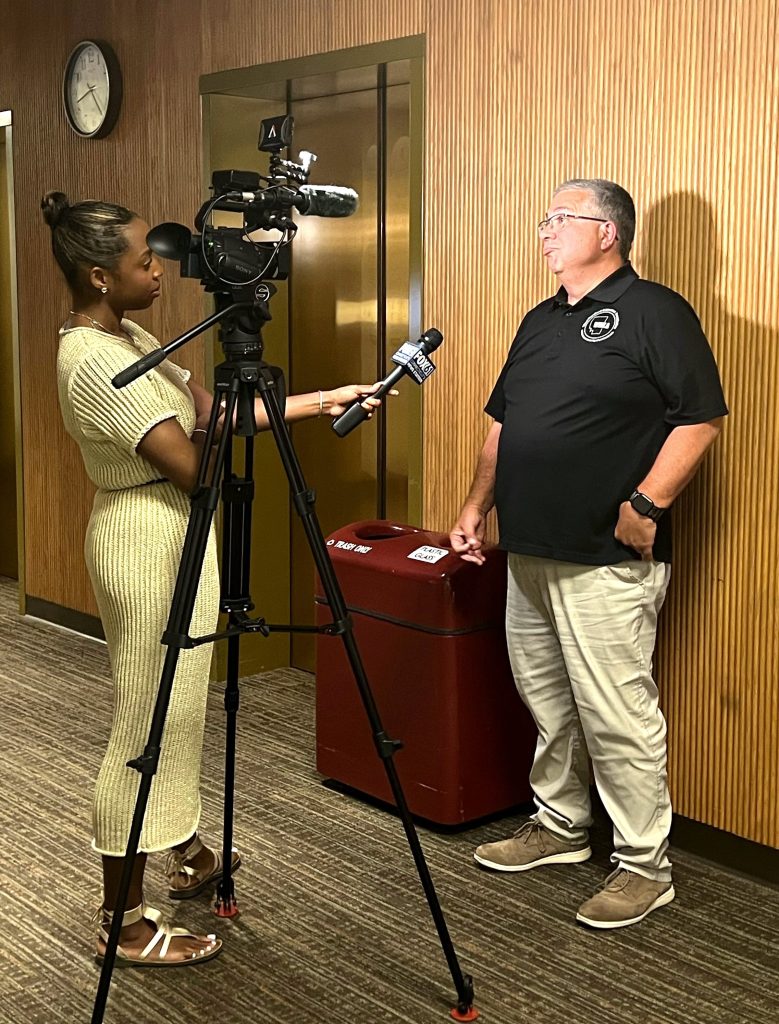
West Hartford Education Association president Brian Putkonen speaks with Fox 61 following the Board of Education meeting.
Administrators argued that teachers voluntarily gave up prep and lunch periods, but the teachers say they had no choice if they were to ensure students were properly supervised and supported in crisis situations. White said she was frequently alone with her students, meaning she could not flex her schedule to accommodate a lunch or prep time.
“A lot of our students have mental health difficulties, and I’ve had to assist them and support them,” White said. “I went to the police station at least two times with students during my lunch period, but I felt like I couldn’t leave a student in crisis.”
“The profession has changed, the demands have changed, the expectations have changed. And where do they go? They go on to the teachers, and that’s concerning,” says WHEA President Brian Putkonen. “I’ve always said my job is to make sure others have a long career such as I have had. I’ve had a great career, and I want other people to have the same opportunity.”
Putkonen says there are many ramifications when there isn’t sufficient staff to allow a school to run as planned.
“Schools run as planned maybe three or four times a year. As teachers, we’re really good at adjusting, but there’s a limit to what you can ask people to do, which is why we have certain provisions written in our contract. Our contract is agreed to by both the union and administration. If we’re expected to follow it, why aren’t they?”
Putkonen adds, “We want teachers to be able to do the best job possible. They want the time allotted in the contract to prepare and do as much as they can for their students. It’s a problem if teachers are missing the time they should contractually have to eat, relax, and regain their energy and to plan for, in some cases, five subjects for 20 kids a day. There’s a limit to what you can ask teachers to do. When we don’t give teachers the time they need during the day, it’s an injustice to students more than anything.”