
Congress has until September 30 to agree on a budget for fiscal year 2026, and as a federal shutdown looms, so also do threats of cuts to education funding.
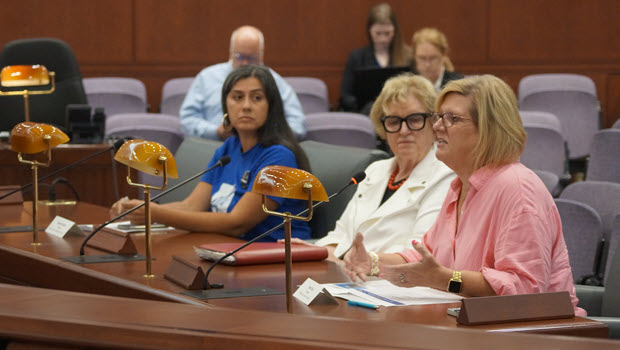
At a forum held by the legislature’s Education Committee last Friday, State Department of Education staff explained the three current federal education budget proposals that have been put forth by the president, House, and Senate. While the Senate’s proposal adds additional funding for fiscal year 2026, the budget proposals put forth by the president and House both cut education spending by billions of dollars.
Most of the federal funding Connecticut receives is targeted at high-needs, low-income districts—meaning these districts would be especially harmed by proposed cuts. While the president’s budget maintains funding for Title I and IDEA, it zeros out funding for Title II, Title III, and state assessments. The House budget cuts Title I funding, as well as rescinding FY 2025 Title I and Title II funds, and eliminates Title II, Title III, and state assessment funding.
Title II provides supplemental resources to school districts to support systems of support for excellent teaching and leading, and Title III provides funds to help English learners succeed in school.
During the forum, CEA President Kate Dias and other education stakeholders said that there is real apprehension about the instability and uncertainty regarding federal funding.
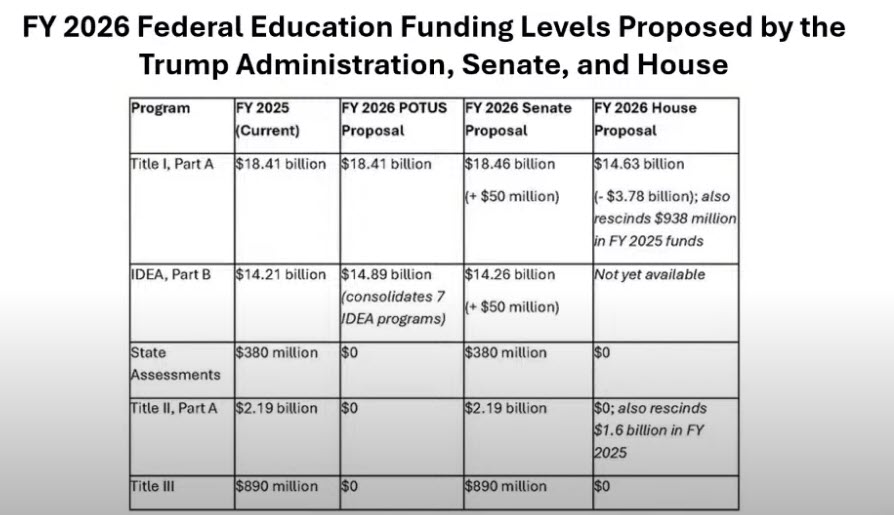
Chart courtesy of the Council of Chief State School Officers. This is a high-level summary and is not comprehensive.
“As we try to forecast this and look at what the genuine impact will be over time, we’re going to start seeing our superintendents and our school districts having to really talk about downsizing in order to ride the wave of uncertainty,” Dias said.
Connecticut Commissioner of Education Charlene Russell-Tucker said that it’s hard for any state to backfill the funding they expect to receive from the federal government.
“Any reductions would impact us,” she said. “We bank on every dollar that we get, and every district works really hard to make sure they can maximize all the funds that they receive.”
Both the president’s and House’s budgets zero out funding for state assessments.
Russell-Tucker said that, per the Elementary and Secondary Education Act, if assessments are not federally funded by at least $369 million, states are not required to administer the assessments.
Dias said that, although the SDE presented data showing that the teacher shortage is not as severe this year as last, the state has lost 325 teaching positions in the last year.
“We’re seeing resistance to adding teaching positions in places where we know we need them, and that’s pushing class sizes up,” she said.
In communities that already have a high property-tax burden, federal cuts could result in significant staffing losses and the closing of school buildings, Dias said.
“Special education funding has been declining from the federal government,” she continued. “The federal government is supposed to fund special education at 40%, but they’re funding at 11%. If they continue to cut that back, those are services we’re legally obligated to provide. Even if the funding is cut, the services need to be put forward, so that funding will have to come from another place. That’s either going to have to come from our state legislature or our local communities. And at the local level we’ve seen concern about cash-strapped households struggling with all of the other economic demands they face.”
Dias said that Connecticut ranks sixth among states in per-pupil expenditure, but 44th in the share of that expenditure covered by state funding.
Education Committee Vice Chair Rep. Kevin Brown, a CREC teacher, said that socioeconomic issues facing families in Connecticut become education issues and interfere with students ability to do well in school. He said that Connecticut students face an opportunity gap, not an achievement gap.
“If we’re not providing opportunities, then we’re at fault,” he said. “We’ll never get the achievement we’re seeking if we’re not addressing the issues. We need to take a hard look at what we can be doing as a state to mitigate whatever factors we get from the federal government.”