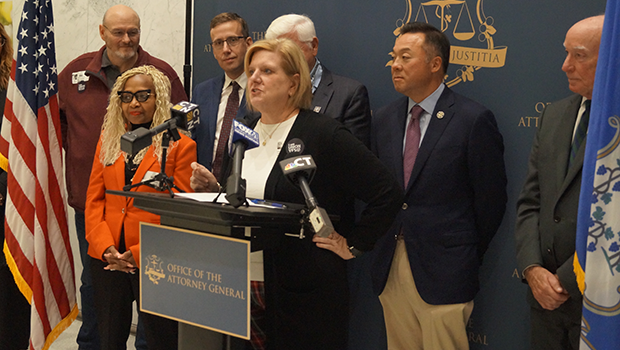
“We need a public service loan forgiveness program that encourages people to get into public service and to stay in public service,” said Connecticut Attorney General William Tong at a news conference this week announcing a lawsuit he and 21 other attorneys general have filed against the U.S. Department of Education for unlawfully restricting eligibility for the Public Service Loan Forgiveness (PSLF) program.
The PLSF allows government and nonprofit employees to have their federal student loans forgiven after ten years of service. The attorneys general are challenging a new federal rule that would deem certain state and local governments or nonprofit organizations ineligible employers for PSLF if the federal government determines they have engaged in actions with a substantial illegal purpose—in practice, activities, or actions that are disfavored by the administration. The coalition argues that the sweeping new rule is unlawful and targeted to punish states and organizations that the administration does not like.
“We are really struggling to attract people to public service,” CEA President Kate Dias told reporters and PSLF supporters. “We see it not just in education but in every field of public service. Student loan forgiveness is a promise made to those who choose to work as educators, medical professionals, and in other public service careers. The new rules restricting loan forgiveness are unfair and just another attempt to penalize educators and other public servants. We stand together to fight this illegal federal overreach. Educators deserve respect, relief, and the ability to teach freely—without political interference or financial punishment.”
Tong said that restricting PSLF eligibility hurts not just those who have chosen careers in public service but also the people that they serve.
“Since 2007, this program has enabled more than one million people to serve the public in this country,” he said. “That is a huge difference and a huge impact in vital fields like education, health care, and law enforcement. In Connecticut, close to 12,000 people have had loan forgiveness under the Public Service Loan Forgiveness program. We have an additional 12,500 borrowers enrolled, and the federal government is about to pull the rug out from underneath them, which is why we have to fight.”
Congressmen Joe Courtney and John Larson, who both spoke at the press conference, were in Congress in 2007 when the House and Senate passed the legislation to create the PSLF program.
“It was a bipartisan vote in the House, 273 to 149, and in the Senate, 78 to 18,” Courtney said. “George W. bush signed it into law—this was a very bipartisan effort because people understood that when you have talented people in college coming out of school they have lots of options, lots of choices, and public service might not be the most lucrative in terms of trying to deal with student loan debt.”
“We can’t thank our attorney general enough for leading this fight,” Larson said. “Our troops, teachers, and first responders shouldn’t have the aid they were promised put at risk because Donald Trump wants to make a political point. Connecticut won’t stand by and let this president weaponize every lever of power to silence dissent.”
“I’ve sat around too many kitchen tables with parents who are concerned about whether or not they can afford to send their kids to college,” said State Rep. Gregg Haddad, who was joined at the press conference by Senator Matt Lesser and Reps. Eleni Kavros DeGraw and Corey Paris.
“Students graduate in Connecticut with a mountain of debt,” he continued. “They are ever questioning whether or not it’s worth it to incur that debt as they’re trying to better themselves and get a college degree. The Public Service Loan Forgiveness program is one way that we can make sure that that dream of getting a college degree remains affordable for middle class people in our state, and it is critically important that we protect it against the attacks of the Trump Administration.”