
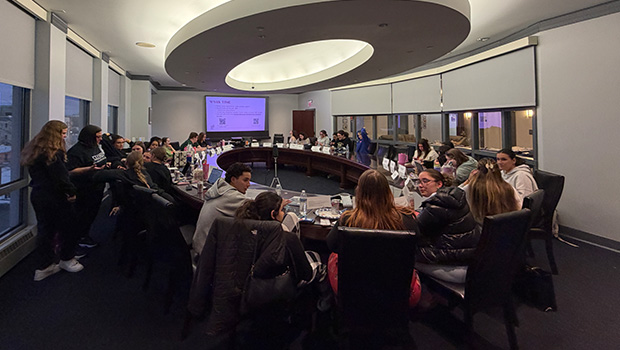
As they look to land their first certified teaching positions, CEA Aspiring Educators (shown here at an executive board meeting) received valuable training in how to shine at the hiring table. Veteran educator and former school administrator Tim Enos, a Mansfield math teacher and interventionist who has taught across all grades—pre-K to 12—shared practical advice with the group and helped them sharpen their interviewing skills.
“The biggest takeaway from interview training is practice, practice, practice,” he said. “That helps you organize your thoughts, articulate your philosophy of education, review recent lessons and activities that demonstrate your skills, and ease some of the anxiety you might feel leading up to the interview.”
Enos encourages applicants to share real scenarios demonstrating how they’ve executed pedagogy, impacted student achievement, and reflected on their teaching.
“Using structured storytelling is a great way to frame your responses,” he says.
“I discovered in this training that it’s not always about how much you know but how you speak about your passion,” said incoming CEA Aspiring Educator Program (AEP) Chair Maia Schwing, who has completed a dual degree program at UConn in mathematics and secondary mathematics education.
Planning a career as a high school math teacher after she completes her graduate work, Schwing says, “I’m most looking forward to building connections with my students and turning my space into a haven for learning both curriculum and real-life skills. Coming out of my student teaching experience, I’ve learned so much about organization and the design of a classroom. I’m excited to do everything from arranging desks to putting up anchor charts!”
She adds, “CEA AEP has been so helpful in introducing me to my future colleagues and to what being an educator is truly like. I’ve learned about my rights as a teacher, what I can do to make the days easier, and how to best support students while ensuring I can show up for them every day.”
Practice, practice
To help aspiring educators prepare, Enos conducted mock interviews with each of them, reminding them to have their “bookends” prepared—namely, answers to the common first question “Tell me about yourself,” and the last one, “Do you have any questions for us?”
“Candidates who research, prepare, and connect their answers to the school or district where they’re applying will stand out and have the greatest chance of landing the job,” he noted.
One of the standout stories from his own experience on a hiring committee involved an interview with a candidate for a position teaching high school physics.
“The school where I worked had an amazing culinary program, and in the middle of the interview, there was a knock on the door followed by students carrying in two giant trays of freshly baked focaccia. We all ate it—the candidate too! We joked that we ended up hiring the person we broke bread with that day.”