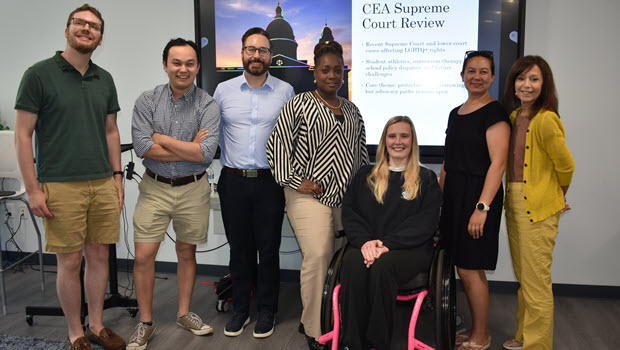
The U.S. Supreme Court’s 2026 term ended with major decisions involving Title IX and affecting LGBTQ+ students and their rights in school settings. At a July 17 information session, CEA Training and Organizational Development Specialist Christopher Teifke and General Counsel Adrienne DeLucca reviewed what those decisions could mean for students and educators.
School sports
On June 30, the U.S. Supreme Court ruled in West Virginia v. B.P.J. and Little v. Hecox, upholding state laws in Idaho and West Virginia that ban transgender girls from female scholastic sports teams. The 6-3 decision determined that these exclusions do not violate the Fourteenth Amendment or Title IX, meaning that states are allowed to ban transgender girls from girls’ sports. To date, at least 27 states have some type of restriction on trans athletes in school sports.
“While the Supreme Court ruling allows these statewide bans, it’s important to note that it doesn’t require them—meaning that inclusive policies remain lawful where state law allows them,” said Teifke, adding, “Connecticut is one such example. Our state explicitly prohibits restrictions on trans students in sports, although we expect challenges to re-emerge this upcoming legislative session.”
Ripple effect
Noting that the Supreme Court’s ruling is limited to sports and does not apply to the use of bathrooms, pronouns, healthcare, employment, and other areas, Teifke cautioned, “The sports boundary will almost certainly be tested, opening the door to discrimination in other areas.” He pointed out
- Some Supreme Court justices assert that the science is not settled on what it means to be transgender, arguing that it is a choice, in the same way being gay was once perceived as a choice.
- The broader implication is that affected populations that are small “don’t count” and may receive less judicial attention.
- While the expressed concerns of states pushing for trans bans in girls’ sports are to protect competitive fairness, many state-level cases have been decided on hypotheticals, not actual cases where individuals were harmed or had their rights violated.
“We’re in this era of trying to decide ‘Whose harm counts?’” said Teifke. “And what are the pathways forward?”
Student protections eroded
Other recent Supreme Court rulings tipped the scales in favor of adults who oppose the idea of young people learning about or identifying as LGBTQ+. In Mahmoud v. Taylor, the Court ruled 6-3 that public schools in Montgomery County, Maryland, must allow parents to opt their children out of elementary curriculum that is LGBTQ+ inclusive if it goes against their religious beliefs. Schools that had tried offering opt-outs quickly found them unworkable, reporting that they resulted in high student absenteeism, the infeasibility of administering opt-outs across classrooms and schools, and the risk of social stigma and isolation for students whose family members are LGBTQ+.
In her dissenting opinion, Justice Sonia Sotomayor asserted that “countless interactions that occur every day in public schools might expose children to messages that conflict with a parent’s religious beliefs,” adding, “If that is sufficient to trigger strict scrutiny, then little is not.”
Another key Supreme Court case centered on “conversion therapy,” a widely discredited practice that attempts to change an individual’s sexual orientation or gender identity, operating on the false premise that being LGBTQ+ is a mental illness. Conversion therapy, strongly condemned by medical and psychological experts because of its severe, long-term psychological harm, is banned or heavily restricted for minors in at least 27 states, including Connecticut, as well as in D.C., Puerto Rico, and 100 municipalities.
In spite of that, the U.S. Supreme Court ruled 8-1 in the case of Chiles v. Salazar that Colorado law banning conversion therapy, as applied to a licensed counselor’s talk therapy with minors, is a violation of the therapist’s First Amendment right to free speech. Justice Neil Gorsuch wrote for the majority that the law discriminated against the counselor’s viewpoints by allowing therapies that support gender transition while banning those intended to change a minor’s sexual orientation or gender identity.
“This ruling essentially allows therapists to discuss the ‘wrongness’ of being gay or trans and to push for conversion,” says Teifke. “Obviously educators and others are deeply concerned about the effect this will have on students’ mental health.”
Schools no longer safe spaces?
Schools across the country have long taken pride in supporting students’ gender identities—including their choice of names and pronouns—without “outing” them to parents. In one such instance, after a Massachusetts student who self-identified as genderqueer came out to teachers, the student’s parents sued the school, asserting that they should have been told. Their complaint was dismissed.
A similar legal case in California, Mirabelli v. Bonta, focused on whether schools can keep a student’s gender identity confidential. School districts had rules directing teachers to use a student’s chosen pronouns but not to inform parents without the student’s consent.
“The goal was to protect young people who had unsupportive families,” said Teifke.
Parents sued, however, arguing that withholding this information violated their fundamental right to direct their children’s upbringing. In March 2026, the U.S. Supreme Court issued an emergency ruling that favored the parents.
“’Emergency’ cases are now shaping major decisions about rights,” Teifke said.
Hope on the horizon
“The legal landscape today is certainly challenging,” Teifke acknowledges, “but it’s not closed. Many protections can still be defended or expanded.”
Ways forward include
- Building inclusive local and school policies
- Enshrining rights in teachers’ contracts
- Pushing state legislatures to repeal or revise bans
- Encouraging political participation and leadership development
- Continuing to center individuals and their dignity and agency
“Lower courts, legislatures, schools, unions, and communities are still key players,” Teifke says. “Connecticut has strong statutory protections for trans people, including in our schools.”
He also emphasizes that while our focus is often on the courts, battles are typically won in hearts and minds.
“Marriage equality is a great example. It became a law after a major cultural shift in which Americans largely came to understand that being gay is not a choice. Individual stories, which humanize a challenge, really helped. First, our thinking changed; laws were then passed to reflect this new thinking.”
Educators respond
“Chris Teifke likes to say that when institutions fail, we rise,” says Tolland kindergarten teacher Tiffany Bardos, who attended CEA’s review of Supreme Court cases. “Of course, we always like to see institutions doing the right thing.”
Bardos takes part in CEA’s sessions on legislative and Supreme Court analysis because, she explains, “So much can change, and it’s important to know what rights continue to be protected, what rights are threatened, and how we are going to advocate for ourselves and our students. Educators are here because we want to stay current and pivot our advocacy where it’s needed.”
“Education is a political act, and we’re all here trying to find ways to support our students,” Jon Russo, program coordinator of Stamford’s high school agriscience program, agrees.
“A lot of times you hear about these issues in the news, and it’s helpful to come to these events and get a pragmatic understanding of what actually happened and what it all means,” says Glastonbury fourth-grade teacher Austin Longendyke. “It sets the stage for what our next steps are in terms of advocacy and supporting our students and colleagues.”
“I consider myself an ally and an advocate,” says Tanesha Jones, a school social worker in youth justice and alternative settings. “As someone who’s new to education, I want to learn everything I can to make sure I serve students, families, and colleagues in the best ways I can.”
Kristen Basiaga, president of the Glastonbury Education Association, notes, “It’s important for someone in my role to stay up to date on how the landscape is potentially changing for our LGBTQ students and educators. By making sure I’m in the know, I’m better equipped to advise not only my students but also my union colleagues of their rights.”
For more information or to get involved with CEA Pride, visit cea.org/pride. There, you can join our mailing list and order “I’m Here” safe space badges that can be worn with your school ID to show you’re an ally.