
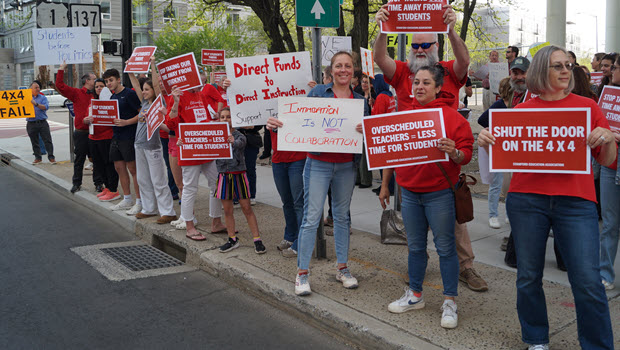
Stamford students, parents, and educators were out in force rallying before and offering public comment during a board of education meeting this week, calling for the district to reconsider the misguided new high school schedule administrators are pushing.
“All of these people here in protest of the 4×4 schedule—it’s not an adversarial action. It’s an act of love and dedication for the students and families of Stamford,” CEA Vice President and Stamford resident Joslyn DeLancey told the board.
Stamford administrators want to implement a new schedule this fall, known as the 4×4 schedule, that would have students take up to four classes during the first semester of the year followed by four different classes the second semester. Teachers, students, and parents have pointed out that the schedule would mean that yearlong classes would have to be compressed into a single semester and some students might go an entire calendar year with, for example, no math class, leading to learning loss far more significant than what is sometimes called the “summer slide.”
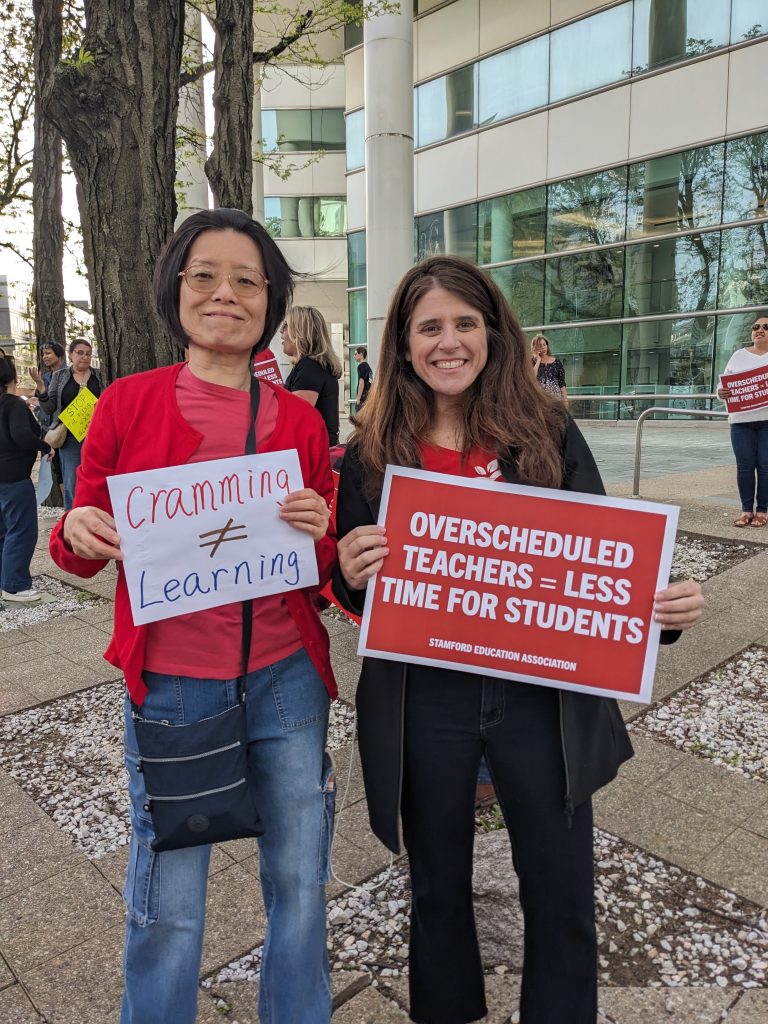 “They’re here, multiple stakeholder groups, speaking about an issue that they are deeply concerned about, and they’re not being heard,” said DeLancey, who teaches in Darien. “It’s unacceptable that you have this many people standing up for a cause and we’re moving forward with something that doesn’t help students. I work for a thriving public school system, right next door, and we’re not going with this schedule. We’re not even thinking about it.”
Currently Stamford high schools are following a seven-period model that is a variation of an A/B block schedule.
Twelve teachers, including Stamford Education Association President John Corcoran, sit on the district-wide committee tasked with developing a new high school schedule. Although teachers were initially told by administration that they would work collaboratively to develop a new schedule, Corcoran says administrators running the committee have completely ignored teachers.
“The SEA asks that this misguided process be halted immediately,” he said. “And although the SEA would recommend that we head back to the old schedule, we ask that the Stamford Public Schools keep the current high school schedule for the 2025-26 academic year. Let’s all sit down together starting this August and truly listen to one another, which doesn’t seem to happen very often in this district, so that we can develop a schedule that’s amenable to all stakeholders for 2026-27.”
Listen to a WICC interview with Corcoran about the high school schedule changes.
 Academy of Information Technology and Engineering (AITE) junior Grace DiGiacomo pointed to the discrepancy between the overwhelming unpopularity of the proposed schedule among the Stamford community and its support from all but two board of education members.
“How can the rest of you possibly support a flexible schedule when every level of the school community has spoken and gets it,” she said. “Parents and students speak to you directly at these meetings. AITE students filled out a survey. About 80 percent of respondents wanted the AB block schedule back and only five percent preferred the new schedule.”
She continued, “Teachers try to speak out, but most are afraid of backlash. And obviously they have a fair reason to be, considering that two of the principals, at Stamford High and Westhill, were threatened with insubordination and getting ‘legal involved’ if their statements against the new schedule continued.”
Grace’s mother, Jamie DiGiacomo, who has a master’s degree in education, told the board that she thinks the schedule change is “about covering classes, not the betterment of children.”
She added, “If this is such a game-changer for our students, why haven’t you shown us the research? The lack of information leads one to wonder whether there is another reason for the change.”
“I urge you and beg you to reconsider this schedule and work with these people here to find a schedule, that’s dynamic, creative, meets the needs of students, and doesn’t shortchange teachers. If this town is not going to listen to students, parents, and teachers and make the right choices for our public schools, then we are going to have some things to think about this election cycle in November,” DeLancey said.