
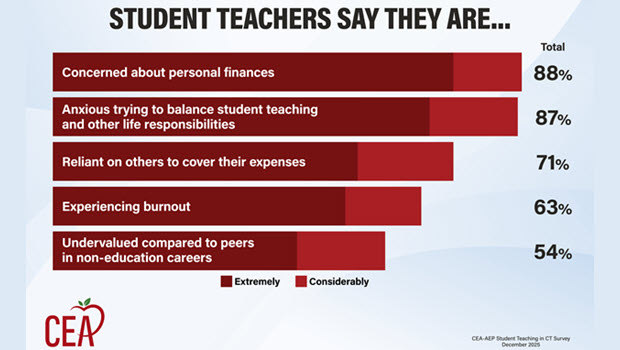
Although student teaching is a full-time professional commitment, student teachers receive no pay, forcing many to take on debt, work additional jobs necessitating long hours, or leave their programs entirely due to the financial stress. That’s why dozens of CEA Aspiring Educators testified yesterday in front of the Education Committee in support of stipends for student teachers.
House Bill 5216 An Act Concerning Stipends for Student Teachers would provide $1,000 per week for every student enrolled in a teacher prep program who takes part in a student teaching experience at a public school in the state and who goes on to work in Connecticut public schools for at last two years following graduation.
“Aspiring educators plan and deliver instruction, assess students, support families, and contribute to school communities, yet most receive no compensation creating a major financial barrier,” said CEA President Kate Dias. “HB 5216 addresses this issue and is a straightforward equity measure. If Connecticut is serious about developing a strong and diverse educator workforce, then entry into the profession must be financially accessible. No candidate should have to choose between completing student teaching and covering basic living expenses.”
“Having been a student teacher myself just one year ago, I know firsthand some of the difficulties student teaching brings for an aspiring educator,” said CEA Aspiring Educator Chair and UConn graduate student Hannah Spinner. “My 12-hour days balancing full-time teaching, attending classes, completing homework, working night shifts as an on-campus resident assistant, and planning for the next day left me exhausted and numb. Though I learned so much from the necessary experience, the endless schedule drained me emotionally and physically, yet I spent countless nights lying awake burdened by stress.”
 Spinner said she found herself jealous of friends in other degree programs who had opportunities for paid internships during their time in college—some earning more in just one summer than she did in an entire year despite constant employment.
“Our current system exploits an extremely female-dominated field for what’s in their hearts and does not provide them the same respect or compensation during learning as many male-dominated fields such as the blue-collar industry, business, or engineering,” Spinner said.
A second-year second-grade teacher in Ledyard, Kate Green recently experienced the difficulties that are widespread for student teachers.
“I completed my full-time student teaching residency for 16 weeks in the spring of 2023 before I could get certified to do what I love,” she said. “Even though I was taking on major teaching and classroom responsibilities during this time, I could not get a second job because the placement was so intense. A stipend would have completely changed my experience. Instead of constantly worrying about money, I could have focused entirely on becoming a better teacher. I struggled a lot, juggling full-time, unpaid work with full-time tuition, and basic living costs. I quit my only reliable source of income, burned through my savings, and had to make tough calls about necessities. The constant anxiety about running out of money overshadowed my focus in the classroom. While I thought about quick side gigs, the demands of student teaching—lesson planning, grading, and coursework of being a college student—made it impossible without sacrificing the quality of my placement or my mental health.”
“None of us choose education for the money, we choose it because it matters, because teachers shape every position that exists today,” said UConn student and CEA Aspiring Educator Stephanie Marino. “Unfortunately, love does not pay rent, passion does not cover tuition, and calling something noble does not make it free. Paying student teachers is a statement of values that tells student teachers Connecticut believes in them. When we refuse to pay student teachers, we don’t save money, we shift our costs. We pay in teacher shortages, exhausted classrooms, students who cycle through substitutes, and the quiet loss of people who would have made extraordinary teachers if we had just made it possible for them to stay.”
“HB 5216 is about access and equity. If we truly want to diversify and strengthen our educator workforce, we must remove financial barriers to entry,” said CEA Educational Issues Specialist Elizabeth Sked. “No aspiring educator should have to worry about whether they can afford groceries or how they will pay for gas while completing a full-time clinical experience. We also support the Connecticut State Department of Education’s plan to expand the educator apprenticeship program. Apprenticeships are an important and innovative pathway into the profession. HB 5216 compliments that effort by ensuring that all student teachers, regardless of their pathway to certification, receive compensation for the critical work they are doing in our schools. This creates consistency and fairness across preparation models.”
Tell lawmakers what’s on your mind—join us for CEA’s Breakfast with Legislators, Saturday, February 28, 9:30-12.