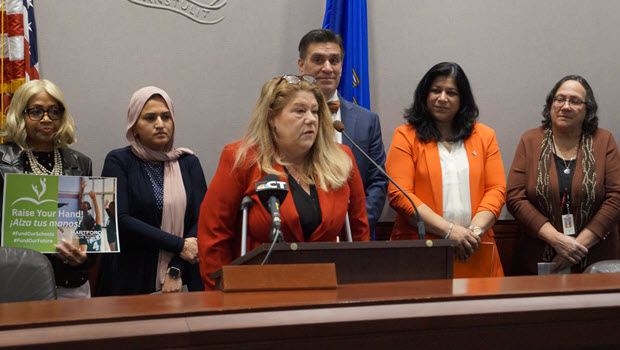
The Select Committee on Special Education is new to the legislature this year—born out of lawmakers’ recognition of the crises facing the field. After months of listening sessions and information gathering, the Committee yesterday held a press conference and public hearing on a bill they have introduced to address the escalating costs, educator shortages, and growing number of students being identified as requiring services.
“I applaud you all. There’s an extraordinary amount in this bill that you’re trying to grapple with,” CEA President Kate Dias told lawmakers during the public hearing that lasted into the early hours of the morning.
“Our workload as special educators has gotten really tenuous—working with CT-SEDS, working with highly intense students,” said CEA Treasurer and special education teacher Stephanie Wanzer (pictured above, at podium). “I think this bill really looks at the kids and the intensity of the workload educators face.”
While Dias and DeLancey noted areas where the bill could be improved, they highlighted the positive steps the bill takes to
- fund special education through new formulas,
- address special educators’ workload,
- ensure instructional support and training,
- raise the age of developmental delay designation, and
- control the costs of private special education providers.
While some parents and special education advocates raised problems with the legislation, CEA leaders and members urged legislators to focus on improvements to the bill.
“Please don’t give up on this legislation,” CEA Vice President Joslyn DeLancey said. “You set out to solve problems, and this bill does a lot of problem solving.”
“In my years working in special education I’ve seen lots of inequities—lots of ways that our current system does not work for all who are being impacted,” said State Rep. Maryam Khan, co-chair of the Special Education Committee and an East Hartford teacher. She noted that she has met with many families who feel shut out of the process, unable to get the services their child needs from the school district and unable to get outplacements due to waitlists and geographic restrictions.
“I’ve also watched districts like my own when I was a board of education member in Windsor struggle with the rising costs while being given very few tools to change the outcomes for students,” she said. “The last three years in our state we’ve seen a 35 percent increase in the tuitions that are being charged by outplacements.”
Granby Education Association President KC Petruzzi noted that her district is trying to build intermediate programming for some of the highest-needs students in order to avoid some outplacements, but said the costs of building the programming are significant.
“It’s difficult to fund this programming when state reimbursements fluctuate throughout the year,” she said. “In order to best serve these students, we need reliable funding that supports appropriate caseload levels throughout the school year to avoid gaps in service provision and maintain safe school environments when high-needs students struggle to regulate their emotions and behaviors in the school setting. Most districts operate with the least common denominator of staffing because of budgetary constraints and a tight labor market. If we invest in this programming to give staff a more manageable work experience, they will provide better-quality service, be less likely to burn out and leave the district or profession, and we may get a better handle on the epidemic of high-need academic and behavioral challenges so many students face.”
Dias highlighted the work committed educators do every day to meet the needs of students with differing needs and noted that recent remarks by Health and Human Services Secretary Robert F. Kennedy Jr. are harmful to students, their families, and educators.
“Educators are outraged over these misinformed statements,” she said. “He is uneducated on the matter, and we take great exception to his comments. These comments are inaccurate, harmful, and disrespectful to the professional educators who devote their lives to working with students with special needs. Every day, teachers and support staff work with students who have a wide variety of needs, ensuring caring, welcoming environments where they are safe, accepted, valued, and can reach their potential.”
“We will be in a lengthy public hearing late into the night tonight because we want to hear all voices,” CEA member and State Rep. Chris Poulos noted at the morning press conference. “Our goal is to make sure that we do right by our communities, the families that live in those communities, and the students we teach.”
Make sure your voice is heard on the need for special education reform and other education priorities. Sign up to attend CEA’s Lobby Day at the State Capitol on Wednesday, April 30.