
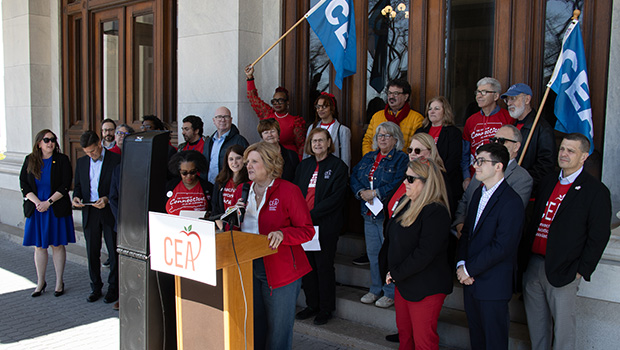
As scores of educators prepared to meet with lawmakers this afternoon in a #RedForEd day of action to push for key education measures, CEA held a press conference outside the State Capitol to articulate those priorities and the need for both passage and funding.
“We have a number of legislative asks before the House and Senate,” said CEA President Kate Dias, “and it’s heartening to know that in this legislative session, these issues have taken up some real space in the conversation. I’m grateful to the legislators who have taken up our causes and understand the important role educators play not just in keeping our public schools strong but in building a robust economy in the state of Connecticut. Our public education system is one of the best in the country, but that’s not by accident, and it needs to be supported with policy as well dollars and cents.”
Money matters
In a poignant illustration of how funding deficits impact educators and students, CEA Treasurer Stephanie Wanzer, a special education teacher, said, “I’m here today for the 94,000 students with disabilities in our state and for the educators who are their fiercest champions. I’m here to tell you that there’s a quiet crisis unfolding in our schools. The proposed $4.86 million rollback to special education enhancement is not just a line item; it’s a calculated move that will harm our most vulnerable students. In the classroom, these cuts translate into three devastating realities. First: unsustainable caseloads. We’re asking special educators to do more with less—to do the work of two or even three people—and they’re breaking under the pressure. Second: burying us in paperwork. Instead of face time with students, we’re drowning in administrative tasks. Third: stalled services. When funding is stripped, speech and occupational therapy, social work services, and paraeudcator supports become luxuries instead of legal rights. Right now, Connecticut is already short 370 special education teachers and over 1,000 paraeducators. Financial desperation is overriding educational integrity, and we’re starving a system that is already hungry. Appropriate state funding isn’t a request; it’s a necessity to ensure our students become successful adults.”
Echoing those sentiments, Representative Kevin Brown—also a teacher—noted, “Education is the most important investment we can make as a state. We need to stop beating around the bush and not lose sight of that.”
Earlier this morning, Brown encountered a group of CREC students who came through the Legislative Office Building, and just prior to the news conference, one of his former students lobbied him.
“This is what it looks like when we invest in our students,” he said. “They use their education to do good.”
Making it count
“Connecticut does not suffer from a lack of financial resources,” Dias pointed out. “We are ripe for an honest conversation about where that money is, where it needs to be, and why we’re cutting school funding. Education boosts our communities and stabilizes our economy, and we will not stop advocating until we have what we need.”
Representative Ron Napoli asserted that Education Cost Sharing (ECS) funding is a high priority for him and his legislative colleagues.
“We need to get more dollars into our cities and towns—not just one-time supplements but long-term commitments.”
Not only is funding important to sustain schools but to sustain the teaching profession itself, several speakers noted.
Retired Bloomfield educator Mary-Kay Rendock, who mentored many student teachers throughout her career, called on lawmakers to establish a stipend for them.
“College interns in almost every other discipline participate in paid internships,” she said. “Why not student teachers? Paying a stipend would level the playing field and allow for a more diverse field of educators.”
“Aspiring educators should not be martyred,” Dias agreed. “They deserve to be able to feed and care for themselves. Unpaid teaching is unreasonable, and more young people today are saying, ‘No, thank you.’”
Left out of the equation
At the other end of the career spectrum, a number of retired educators are also doing without, said CEA-Retired President Mary Beth Lang, pointing out that when healthcare subsidy rates were increased a few years ago, an estimated 50 teachers were inadvertently overlooked and now face increased healthcare costs on fixed incomes.
“We have an opportunity to correct this oversight in the Teachers’ Retirement Board disability subsidy,” she said. “The cost to the state is modest, but the impact on these 50 individuals is significant and immediate. As we work to address this inequity in the budget, we must also continue to equitably fund teachers’ pensions,” she added.
Setting the tone
“Most of our legislative asks this session come with minimal costs,” said CEA Vice President Joslyn DeLancey. “Our teaching conditions are our students’ learning conditions, and the place that sets the tenor for what that looks like is right here, at the Capitol. We have teachers here today on their spring break—that’s how important this is.”
Of course, for every teacher who is willing to voice concerns about what’s needed, many others resist speaking out for fear of retaliation. Two key policies CEA is advocating for would address those concerns.
“Right now, anyone off the street can get a teacher’s home address through a Freedom of Information Request,” DeLancey said, calling on the legislators to close that loophole and protect teachers’ privacy. “We need to know we are safe.”
Representative Matt Blumenthal, a champion of those protections, called them “a commonsense step against abuse,” adding that teachers should not have to fear for their safety and that of their families.
“They should not have this on their doorsteps. It’s time to end it, and I’m proud to support House Bill 5548, which would do that.”
Speaking publicly not only poses personal safety risks but also comes at great professional risk for teachers as well, noted CEA Secretary Gail Jorden. To remedy that, the veteran Bloomfield educator called on lawmakers to enact a fair termination process for her colleagues.
“We all know the teaching profession is one we are looking to grow, but in addition to all the hoops we have to go through, in the end, if someone doesn’t like your personal views, you can be put before your board of education and simply let go. Teachers are just asking for what everyone else already has—the same protections already in place for school custodial and secretarial staff, and everyone else in the school building.”
Senator Julie Kushner, a strong proponent of fair process, pointed out that two proposals now before the Connecticut General Assembly—House Bill 5003 and Senate Bill 351—would provide a fair mechanism for teachers in termination procedures.
Pointing out that boards of education are not trained in labor relations, she stressed that neutral arbitrators—who have that training—should make the final determination in termination proceedings.
The time is now
“This is the year we can pass fair process with neutral, binding arbitration and show teachers that we have their backs,” Kushner said, “because we know how important they are to the education of our children.”
“We really need to be acting on all fronts, starting with the ECS formula and protecting teachers, investing in teachers, and investing in our students and our future,” said Senator Sujata Gadkar-Wilcox. “We should have acted yesterday. We have to act now.”
Also in attendance to show their support were Representatives Marcus Brown, David DeFronzo, Josh Elliott, Chris Poulos, and Kaitlyn Shake. Broadcast on Facebook Live, the news conference can be viewed in its entirety here.