
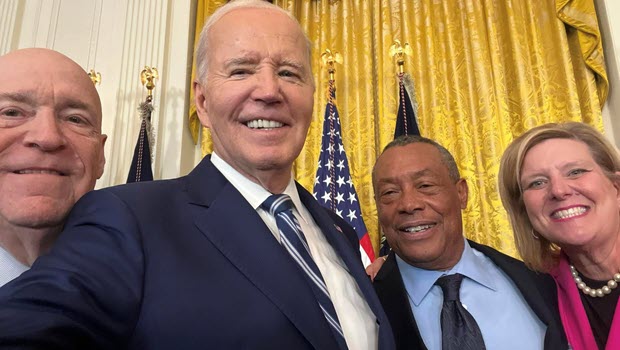
One year ago today, teachers and public servants secured a historic win: the repeal of the Windfall Elimination Provision and Government Pension Offset. When President Biden signed the Social Security Fairness Act into law on January 5, 2025, decades of advocacy paid off—ending unjust penalties and finally delivering the full Social Security benefits educators had earned and long deserved.
That victory did not happen by chance. CEA members and leaders were at the forefront of the fight, organizing, testifying, meeting with lawmakers, and sharing personal stories that put a human face on an unfair system. Through years of sustained advocacy and partnership with allies nationwide, CEA helped turn long-standing frustration into meaningful action—and ultimately, into lasting change for educators and retirees across Connecticut and beyond.
“Being in the now gone East Wing of the White House for the signing of WEP/GPO repeal was a pretty amazing way to start 2025,” says CEA President Kate Dias. “It was such a highlight and a moment where we as public servants really felt valued, seen, and cared for. Since then, we have seen millions of dollars returned to our members, and that’s extraordinary.”
“CEA members really stepped up to tell their stories so that people could understand exactly what was happening,” says CEA Vice President Joslyn DeLancey. “As CEA leaders, we made frequent trips to D.C. to lobby members of Congress and connect with leaders of other unions. Our CEA communications team created a website showcasing members’ videos along with statistics, talking points, and action steps members could take to raise public awareness about the problem and press Congress to finally fix it. CEA’s government relations staff did significant outreach, and our organization as a whole communicated the message by every means, from news releases to social media posts to podcasts, exerting continuous pressure on Congress to repeal WEP/GPO.”

CEA-Retired member Melissa Robbins.
Last winter and spring retired teachers began receiving their adjusted Social Security monthly benefit, as well as a one-time retroactive payment to make up for the underpayments they received in 2024. The increased income has been a big help for many retirees, allowing them to pay bills more easily, grow their emergency fund, or even make fun plans like taking a vacation.
“Now that WEP/GPO is repealed, with the amount that we’re getting in Social Security plus the fact that we got a retroactive payment, my husband and I were literally able to buy a car because we had a really good down payment,” CEA-Retired member Melissa Robbins shares.
Robbins and her husband, a veteran, closely followed the work of the National WEP/GPO Repeal Task Force, on which DeLancey served, and wrote letters to their members of Congress. Before repeal, the two only received $120 a month in Social Security benefits and are now receiving $650 a month.
“I really appreciate everything that Congress did so that the people who had been missing out on their full Social Security are finally getting it,” Robbins says.
“When I retired 17 years ago, even though I had 40 quarters, they were from way back in my teenage years, so I never earned enough Social Security income to even cover the cost of Medicare,” says retired teacher Cindy Lathrop. “Since I’m now able to collect the spousal benefit, it’s taking a lot of pressure off me. I am that person that pays the bills on the first of every month, and that is much easier to do with this extra money. I don’t have to keep switching from savings to checking and savings to checking. It has made my life easier.”

CREC teacher Clare Neseralla and her family.
It’s not just retired teachers who appreciate the financial security brought about by WEP/GPO repeal. Many active teachers now have fewer worries about their finances in retirement and may be able to retire sooner than they previously anticipated.
Before becoming an elementary school educator and STEM coach 27 years ago, CREC teacher Clare Neseralla had a decades-long career in broadcasting and marketing communications and spent four years in business for herself.
“For half my working life, I contributed to Social Security both as an employee and employer,” she says. “After switching to a teaching career, it looked like I would be facing a 40–50 percent cut to my Social Security benefits and the loss of my survivor benefit. Even though my husband had paid into Social Security for years, before WEP/GPO was repealed, I would have been left out in the cold when he passed away. We have a child with special needs, and I will be parenting and helping her navigate the world for many years to come, so this matters to our family. When you pay into Social Security, you’re told that money is coming back to you, and then to be told picking a career as a public servant will erase all of that makes no sense. Many of my colleagues have also worked prior jobs or taken summer jobs, and we all faced the same thing.”
Neseralla’s first-ever outreach to a legislator was about WEP/GPO.
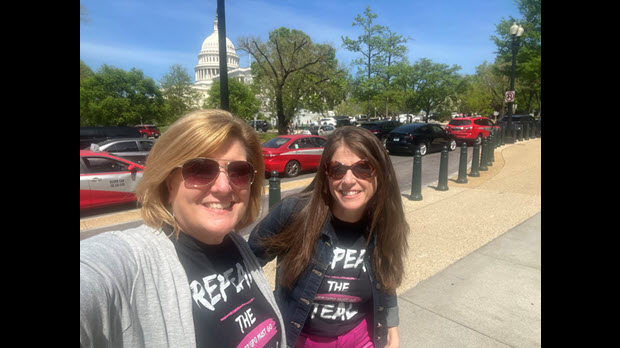
CEA President Kate Dias and Vice President Joslyn DeLancey visited Washington, D.C., numerous times in their efforts to repeal WEP/GPO.
“That was 20 years ago, and I continued testifying about it until repeal,” she says, adding, “It was a hard battle. There was a real lack of knowledge not only among the general public but among many of our legislators, and it was a groundswell of teachers’ voices that brought the issue to light. I hope this makes a difference for people who are thinking about becoming teachers, because while the job is hard, it’s also rewarding. Second-career teachers bring a special perspective to the classroom, and by eliminating the financial impact of WEP/GPO, we can now bring more of that talent into the profession.”
She adds, “Thanks to the repeal of WEP/GPO that CEA worked so tirelessly for, my benefit will be close to $1,000 a month. It’s very satisfying that our collective advocacy and action brought results.”
“The impact of this victory was immediate and will also be felt for generations,” says DeLancey. “WEP and GPO were barriers for people coming into our profession who had previously worked in the private sector. Now those barriers are gone. We can start welcoming people to the profession to begin their second careers.”
“It was an overwhelming feeling not only to bear witness to this historic event but also to know that we played a key part in it and that our determination to see this through has improved the lives of millions of Americans,” says Dias. “This victory belongs to every CEA member who stood up and said, ‘Enough is enough.’ Your emails, calls, and stories moved mountains. Together, we got the job done.”