
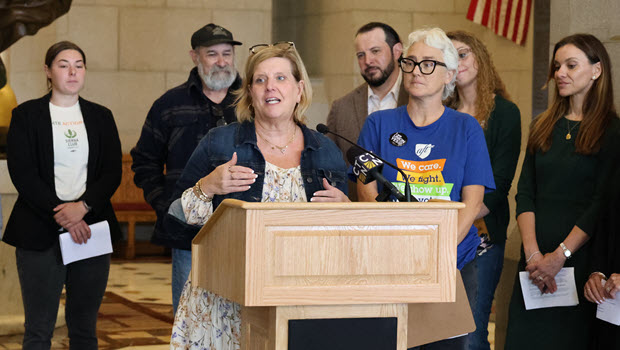
Education advocates, health professionals, and lawmakers are joining together to highlight the need for continued progress on school indoor air quality in Connecticut. With the 2026-2027 school year underway, educators and environmental health advocates came together at the State Capitol yesterday to call on the state to provide greater supports and accountability for school districts that have failed to meet minimum school inspection requirements and invest in urgently needed school IAQ improvements.
“It’s really important that we acknowledge how far we’ve come,” said CEA President Kate Dias. “I am deeply appreciative of the work that the legislature has done. I am really grateful to see that indoor air quality related matters, the heating and air conditioning systems, have been rolled into the bond system, making them a regular part of building maintenance.”
“We are talking about indoor air quality now as a result of the work that was initiated in 2022,” said New Haven Federation of Teachers President and AFT Connecticut PreK-12 Divisional Vice President Leslie Blatteau. “There are signs of real progress, but we must remember that our working conditions are our students’ learning conditions. We are in this together—workers, students, and families. This is a top priority for us as union leaders.”
“More than 60% of our schools right now are not in compliance,” Dias said. “They have not done the reviews necessary, and of the 40 that have submitted reports, many of them are incomplete and have issues with them, so that does signify that we’re not taking this issue as seriously as we need to on the ground level. To do that, we need to recognize that all the laws and the rules that are passed by our legislature are only as good as the enforcement, and I do believe the next question is: what does it take to get 100% of our schools across that finish line of looking at their systems, looking at how they’re working, and determining what they need to do to make the environment healthier and safer?”
“As a mom of a sixth grader in the New Haven Public Schools whose music teacher just reported a significant mold outbreak in her school today, this is ongoing and active, and we should have much more urgent concern as a state,” Blatteau said. “We know the reality of two Connecticuts shows up here again, that the schools that serve more low-income students and families are at a disadvantage when it comes to how we fund our capital budgets, and as a result, we are left with a shoestring budget to maintain buildings for our many, many students who come with complex needs and oftentimes compromised health because of the neighborhoods that they live in. We also know that leaks and mold and broken HVAC are disruptive to teaching and learning. They’re disruptive to attendance. And we know superintendents across the state have goals to increase attendance.”
Next steps
Blatteau said that the IAQ advocates will continue to urge the legislature to allocate more resources so that districts can build capital budgets to adequately meet the needs in their buildings. She said they also want local accountability.
“Accountability does not mean punishment. I am here as a union leader to say, I don’t want the board of ed to be punished. Punishment doesn’t change behavior; support changes behavior. We need more support, so that there can be increased compliance.”
UConn’s Indoor Air Quality Initiative Director Marina Creed said that the classroom air purifiers her program has available to districts remove 99.4% of airborne viruses as well as capturing mold and dust particles.
“Well-designed and properly maintained HVAC systems remain the gold standard for healthy school buildings,” she said. “In-room filtration provides an important additional layer of protection.”
UConn’s program is already operating in 18 districts and is accepting applications from educators and parents to provide schools with the supplies to build DIY air purifiers, along with STEAM-based lesson plans designed to teach students about air quality science.
“Unfortunately, we are often still providing Band-Aid solutions instead of real solutions,” Dias said. “I love the work that UConn is doing, and I am so appreciative of them stepping in to try and find an answer, but this is not a solution to a systemic problem. It doesn’t solve the systemic problem of addressing the state of our infrastructure. That needs to be a priority for our state government and to be fixed on a much broader scale.”