
The Capitol has been the center of a powerful statewide show of support today as buses from 11 school districts rolled into Hartford, carrying students and educators who joined other education advocates united behind one message: Connecticut must invest more in its public schools. It was clear to everyone at the Legislative Office Building that today wasn’t just another day at the Capitol — it was a powerful show of statewide support for fixing how Connecticut funds education.
Hearing rooms quickly filled as two morning news conferences brought together students, teachers, mayors, superintendents, and legislators all calling for meaningful increases in state education funding. And as an Education Committee hearing stretches late into the night, hundreds more residents have lined up to testify — determined to ensure lawmakers hear directly from the people most impacted by the outdated funding formula.
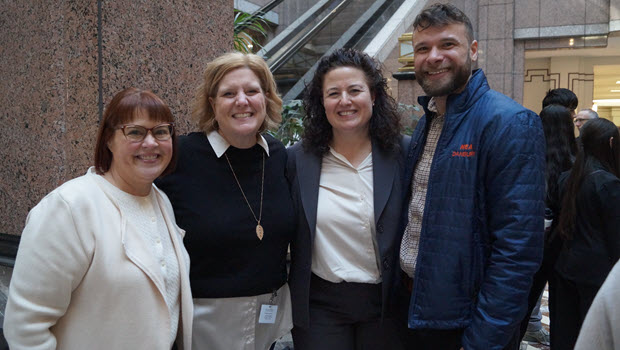
[Pictured above are Danbury teacher Heather Lorenz, CEA President Kate Dias, Danbury Superintendent Kara Casimiro, and NEA Danbury Vice President Julian Shafer.]
At the heart of the push is the Education Cost Sharing (ECS) formula — the primary way Connecticut distributes state education funding to local districts. While costs for special education, transportation, staffing, and instructional materials have steadily climbed, the foundation amount at the core of the formula has remained frozen for more than a decade, failing to keep pace with inflation. Educators say updating the ECS formula isn’t just a policy tweak — it’s an essential step toward giving districts the resources they need to meet the real and growing costs of educating today’s students.
That’s why lawmakers are considering Senate Bill 7, An Act Concerning Educational Equity. The proposal would increase the foundation allocation in the ECS formula — the estimated cost of educating a general education student — from $11,525 to $15,500 by 2031, with annual inflation adjustments built in moving forward. Supporters say the change would finally begin aligning state funding with the actual cost of educating students and better supporting districts across Connecticut.
“The current funding level is a fraction of the true per pupil costs of schooling in our state, leaving Connecticut’s rural, urban, and suburban school districts underfunded,” explained CEA President Kate Dias. “This bill is a significant step toward achieving fiscal equity in public education.”
She continued, “Recognizing the significant needs of many of our districts, CEA urges the committee to consider increasing the foundation allocation of ECS at a greater speed and over a shorter period. While the legislature has made progress in funding the foundation formula in recent years, many of our districts still face significant funding needs. If the foundation level were adjusted for inflation, it would be $16,278 today. Bringing the funding into 2026 dollars is a first step on the road to recovery, so that our schools have the resources to meet the growing needs of today’s students.”
Educators speak out
A number of teachers, many from distressed municipalities, shared with legislators the impact that insufficient funding has had on their students.
“The lack of state funding adjustments has forced our city to increase their own municipal education contributions year after year, putting a significant financial burden on the residents of our city,” noted Danbury High School teacher Heather Lorenz. “This inflationary pressure with no increased state funding, has effectively caused our districts to cut programs, increase class sizes, and limit enrichment opportunities for students including the arts and library media science. We now have issues with the retention of qualified educators and the ability to fill those positions. Special ed teachers in my high school teach additional classes without compensation, causing them to leave for other districts, creating shortages we can’t fill. Counselors have caseloads of 300-400 students. AP teachers don’t have enough new textbooks for students, leaving the teachers to assign different readings to students in the same class.”
Fellow Danbury teacher and NEA Danbury Vice President Julian Shafer observed that when you compare Danbury schools with similarly sized districts that have a greater property tax base, Danbury has two-thirds as many educators.
“Teachers have told me about going out of pocket to pay for curricular materials, and for accommodating students legally mandated IEPs,” he reported. “Many of the facilities in our district are aging, and in some cases, have posed health risks to the students and teachers in them. The educators in our schools do schools amazing work — Brian Betesh from Westside Middle School won teacher of the year this year — but our students and teachers need and deserve more. I grew up in the Ridgefield Public School system, where class sizes were small, counselors had time to connect with students individually, and many facilities were state of the art. This should be the standard for all children in Connecticut.”
Fairfield teacher and Stratford Town Councilor Lisa Carroll shared with legislators that even in better resourced districts, frozen ECS funding is hurting students’ education.
“I have seen firsthand how ECS funding — or the lack of it — affects students, educators, and communities. Last year, my high school reading interventionist position was eliminated without a clear explanation, even in an affluent district. That role supported students who had made it to high school but were still struggling to read fluently. If districts with strong local resources cannot reliably maintain these positions, imagine the challenges for districts with fewer resources.”
Bridgeport educator Jason Poppa teaches in one such community.
“In an urban district like ours that lives ‘paycheck to paycheck’ the staffing and program cuts hit us sooner than most other districts,” he pointed out. “From about 2013 on our school district has had to make catastrophic cuts that would be unimaginable in most other school districts. We have had to forgo school repairs, we’ve lost hundreds of staff positions, and the negative effect on students is immeasurable. Why has this been allowed in school systems like Bridgeport? We have lost math and literacy coaches in almost every school, school librarians are nonexistent in our school system, students in some schools don’t have access to a nurse every school day, and many staff to student ratios for support services are extraordinarily high.”
“We must make intentional investments for staffing and educator compensation to create the school environments we want to see,” urged CEA Vice President Joslyn DeLancey. “Improved conditions for teaching and learning lead to improved student outcomes and support the retention of quality educators. We applaud the Education Committee for proposing legislation to adjust the ECS foundation for inflation. This is a welcome and long overdue measure to give our school districts the resources they desperately need. These changes are ambitious, but they are possible given potential revenue streams currently under consideration. We ask that you support these measures and ensure their passage.”