
Recent changes to federal student loan policy are threatening to shut the door on graduate education for thousands of teachers, nurses, social workers, and other essential professionals. As federal support is rolled back and borrowing options shrink, students pursuing advanced degrees face growing uncertainty about how they will pay for their education. In response, Connecticut lawmakers are advancing a state-level solution designed to preserve access to affordable financing and protect the future of the state’s public service workforce.
Due to H.R. 1, also known as the One Big Beautiful Bill Act, beginning in July, students in education, nursing, social work, physical therapy, public health, and a variety of other graduate programs will face federal borrowing limits of $20,500 per year (or $100,000 total). H.R. 1 also eliminates the Graduate PLUS Student Loan Program, which graduate students have relied on for the last 20 years to bridge the difference between federal direct loans and the cost of attendance. After July 1, once graduate students have exhausted their federal loan eligibility, they will be forced to turn to private loans to finance the rest of their graduate degrees.
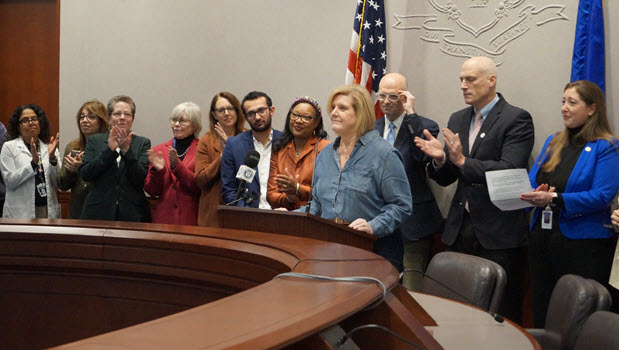
“The federal government is closing the door on opportunity by cancelling the federal Grad PLUS loan program, ending an essential program that has allowed thousands of students to afford to earn a graduate degree. There is no way of knowing if the private loan market will offer loans to people with no credit history or who come from low and moderate-income families,” Rep. Gregg Haddad, co-chair of the Higher Education and Employment Advancement Committee, said at a press conference today at the Legislative Office Building announcing the committee’s proposal.
“The U.S. Department of Education’s plan to discontinue the federal Grad PLUS loan program is part of a broader, ongoing effort by the Trump Administration to defund and undermine higher education in this country,” said CEA President Kate Dias. “We need talented, educated professionals from all walks of life to compete in the global economy. By allowing this critical program to sunset, the White House is throwing away another proven, effective tool that supports underserved and low-income students who deserve a quality education. CEA supports legislative efforts to establish a strong alternative to the Grad PLUS loan program, ensuring Connecticut graduates continue to have access to essential financing for graduate education.”
“While Washington retreats from their responsibilities, Connecticut is ready to lead. We have a proposal that can directly mitigate the damage and protect our students from these federal cuts,” Haddad said. “We’re calling for the empowerment of CHESLA (the Connecticut Higher Education Supplemental Loan Authority) to expand their reach and their resources and enable them to do what they do best and provide reliable, transparent financing for students at a reasonable cost. By strengthening our state-based authority, we can ensure that students have the ability to become a doctor or scientist or a nurse or an educator and have their career choice determined by their drive and their talent—not the size of their bank account.”
“We have a lot of work to do on affordability and on strengthening our economy this legislative session, and this proposal, which is going to be one of the top priorities of the Higher Education and Employment Advancement Committee, addresses both of those issues,” said Sen. Slap, the committee’s co-chair.
The proposal would invest $10 million in state funding and use $20 million of CHESLA’s funds to create a new state-level graduate loan program in the upcoming legislative session to fill federal gaps. CHESLA is a quasi-public state authority created to offer students and their families cost-effective financing options for higher education.
“Aspiring educators already face a wide range of financial barriers and challenges in completing their education,” said Hannah Spinner, chair of CEA’s Aspiring Educator Program and a graduate student at UConn. “Connecticut lawmakers must act quickly to establish new funding mechanisms to help students affected by these cuts so they can focus on their studies, not have to worry about how they will afford tuition for the upcoming school year.”
“Where the federal government fails, Connecticut can and should continue to support aspiring professionals that require advanced higher education degrees. Investing and expanding CHESLA creates a pathway toward protecting student’s professional pursuits, their long-term economic security, and Connecticut’s workforce,” said Rep. Kaitlyn Shake, a union member and nurse with over a decade of experience caring for the needs of women and children. “These are careers that are built on rigorous educational training, expertise, and a deep responsibility to serve the public, and they deserve respect and support, not erasure. Let’s be clear—the degrees the Department of Education is choosing to exclude from the ‘professional’ category are overwhelmingly held by women and people of color. Their proposal will widen income inequality, limit federal financial aid for graduate students pursuing these careers, and push them toward predatory private loans as they try to advance in their fields.”
“This is our moment as a state to put our money where our mouth is,” Dias said. “I don’t know about anybody else, but I’m a little tired of being thanked and not paid. People need to understand that there is a price tag attached to this professional commitment and loyalty. We are excited to support this initiative, and we will be strong advocates about the importance of supporting these professions.”