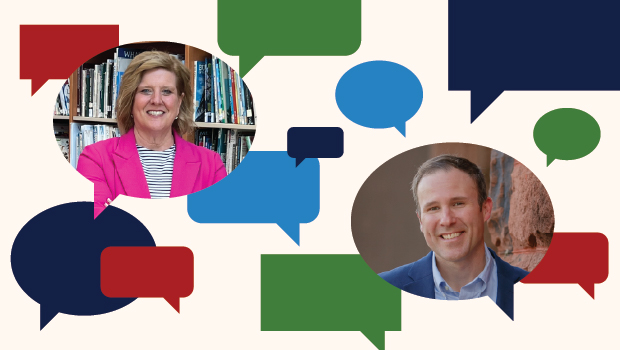
“I appreciate that you continue to put one foot in front of the other and fight the good fight for public education despite our current climate,” CEA President Kate Dias told the more than 100 local union leaders from across the state who joined her yesterday for the virtual CEA County Forum.
With the federal government now in shutdown and a fiscal year 2026 budget yet to be agreed on, Dias says what cuts education funding may face remain unknown. She told educators that they may start seeing districts adjusting programming this year in anticipation of cuts.
“Many of the proposed federal cuts would not impact us until the next academic year,” she said. “We’re looking at what is going to impact us in this current academic year, and we are monitoring the entire federal situation closely.”
The Connecticut General Assembly is gearing up for 2026 legislative session, which is not a budget setting year, but Dias said federal cuts may mean the state legislature needs to make bigger budgetary adjustments than they ordinarily would.
“Realistically, the state cannot make up the $7 billion that we get from the federal government, so there is really no scenario in which, if all the federal cuts that are currently in queue to occur, if they do all come to fruition, there will not be net losses of services to children.”
State Rep. Kevin Brown, a CREC social studies teacher and the vice chair of the legislature’s Education Committee, joined the County Forum to talk about issues the legislature is considering this year and the possibility for a special legislative session this fall.
There is no confirmation yet, but the legislature is considering holding a special session this fall to address issues they were not able to wrap up in June. Legislators plan to revisit a vetoed affordable housing bill, respond to federal spending cuts, and possibly take on an education bill as well.
“The thing to know about special sessions is that they’re hyper specific,” Brown said. “We can only do business around very specific issues. Whatever the governor sets as the actual specific bills that we can debate and negotiate during the session is all we can do, so we can’t take up other things or add other bills to it.”
In the coming legislative session that begins in February, Brown plans to continue to push for a State Seal of Civics Education and Engagement and says the Education Committee will likely also discuss smart device policies, phasing out kindergarten start-age waivers, and school funding.
“It’s the responsibility of the state, it’s in our state constitution, unlike the federal constitution—we are on the hook to make sure that every child gets the fair, measurable education they deserve. It’s on the state to fund that, to resource that,” he said.
Dias encouraged educators to make sure their legislators know where they stand on the issues impacting students and schools. CEA will host a Breakfast with Legislators again this February, which provides an opportunity for legislators to hear directly from CEA members on a number of issues.
Dias also shared that CEA has a record 52 members running for local elected offices around the state this November.
“I’m thrilled to share that as it really speaks to educators’ awareness that if we want to be part of any solutions, we’ve got to actually jump in the pool,” she said. “I want to give a huge shout out to our members that are participating in the electoral process.”