
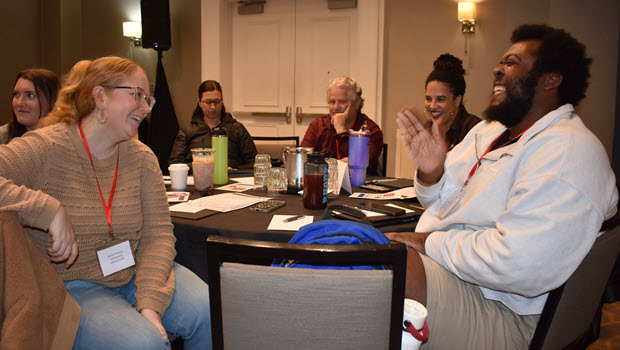
For districts with school closures, Election Day offers an opportunity for professional learning. Hundreds of educators decided to get theirs at CEA’s Reimagining Education conference, an annual collaboration with the Connecticut Education Foundation and Southern Connecticut State University’s Teacher Leader Fellowship Academy. Held in Rocky Hill, this year’s conference featured keynote speaker “Teacher Tom” Hobson, an early childhood educator and author, followed by a rich lineup of breakout sessions.
The theme, Powered by Curiosity: Reimagining Learning from Pre-K to 12, resonated strongly with educators across subjects and grade levels.
“One of the challenges in education is that we have too many mandates that sap the joy out of teaching and learning,” said CEA President Kate Dias, a veteran high school math teacher. “Across our schools, teachers, administrators, and students are all feeling the weight of growing demands and the pressures of rebuilding community in the face of challenges around morale, burnout, and school climate. As educators, we know that the heart of a thriving school is its culture, one built on curiosity, connection, and care. So we’re here today to focus on practices that make our classrooms places of joy and belonging.”
Educating through play
Hobson, whose blog has chronicled the life and times of his preschool in the Pacific Northwest since 2009, shared anecdotes and insights from his own experience as well as research findings that support joyful learning—which includes discovery, exploration, and risk-taking.
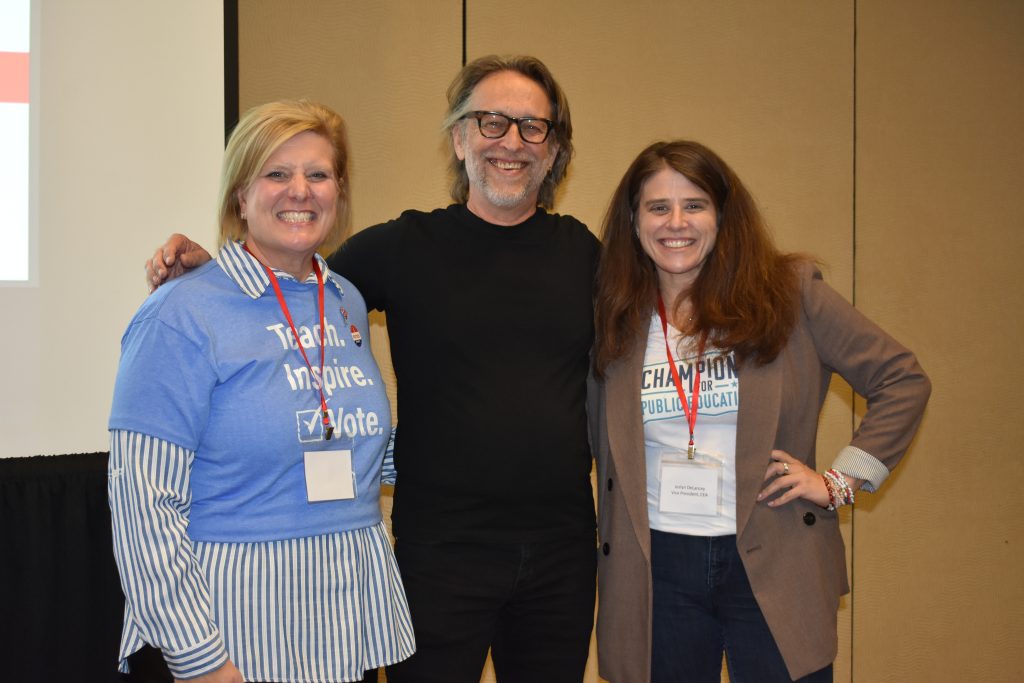
Teacher Tom, pictured with CEA President Kate Dias and Vice President Joslyn DeLancey, is an early childhood educator and author who gave the conference’s keynote address.
He began with a 1960s study measuring the creative genius of NASA engineers, where roughly two percent of adults score at a genius level in creativity. When applied to children, however, the test shows genius-level creativity in 98% of four- and five-year-olds.
Curiosity and imagination drive children, Hobson explained, and play is key to their success.
“Play isn’t extracurricular,” he emphasized. “It’s self-directed learning. It is the curriculum. Psychologist Edward Hallowell observed that the opposite of play isn’t work; the opposite of play is rote.”
“I loved the keynote address,” said Simsbury eighth-grade math teacher Nicole Criss. “Even though it was regarding preschool education, there’s just so much you can take from it for kids of any age. I’m feeling inspired and motivated to try new approaches with my students.”
She added, “At first, as an eighth-grade teacher, I wasn’t sure I should be here, but everything I’m hearing I just want to take back and apply to math. Kids need to be able to make mistakes, they need to experience learning instead of just having me teach concepts to them. And you know, you can play in math—kids should be playing in math.”
Joy for all ages
In addition to the keynote address, Hobson presented morning and afternoon workshops on language that educators can use to inspire creativity, cooperation, and critical thinking and, conversely, inhibit it. Other breakout sessions included
- Developing and Empowering Teacher Leadership in Times of Chaos
- Executive Function and Play-Based Learning
- Improving Student Engagement Through Improv-Based Teaching
- Sitting in the Struggle: Building Resilient, Independent, Confident Children
- Engaging the Whole Child
Naugatuck High School technology teacher Melissa McInvale participated in the improv session.
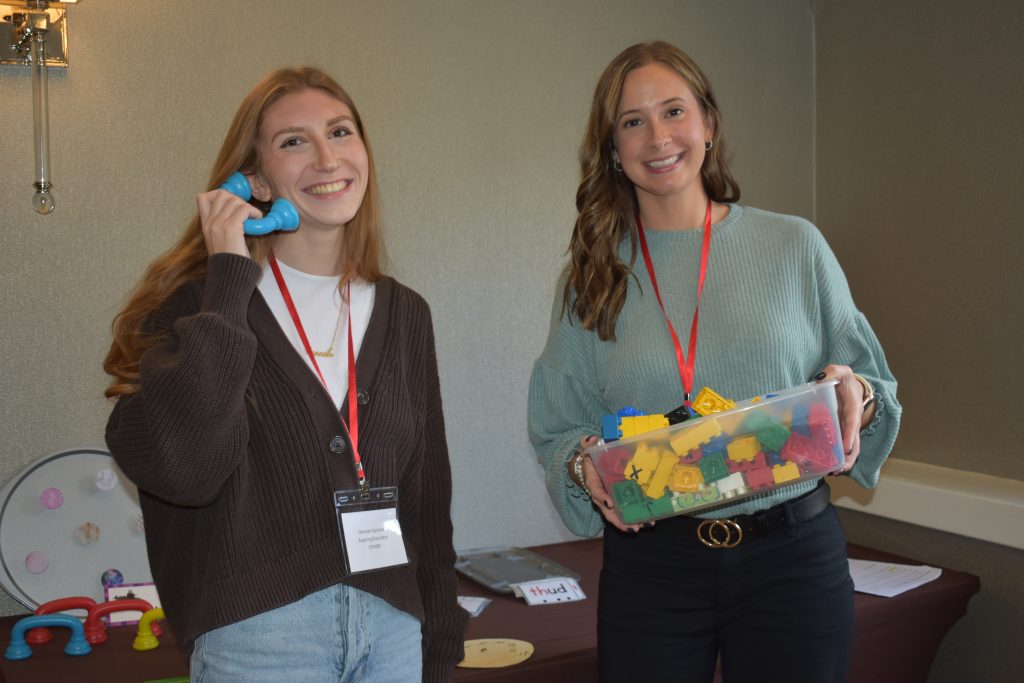 “I’m always looking for ways to bring joy into my classroom,” she said, “and that training was awesome. Kids spend a lot of time at school, and our classes are in a block schedule—so that’s 86 minutes of sitting in a seat, times four. That’s difficult for kids. The improv session gave me ideas I’ll definitely bring back to my classroom. As a technology teacher, I’m always trying to get kids to think outside the box. Getting kids to brainstorm and be willing to take part in activities they perceive as risky is key.”
Bethlehem integrated preschool teachers Kathleen Aldrich and Valerie Altieri were equally excited to participate in the day of learning.
“Play is such an important part of what we do with our students every day, and I have followed Teacher Tom’s blog for years,” said Aldrich.
“I appreciate hands-on professional development, and I’m interested in capitalizing on students’ curiosity and love of play to re-energize our classrooms and give us new ideas,” Altieri added.
Sallianne Norelli, a first-grade teacher in East Haddam, is working on starting a play cafe in one of her school’s spare classrooms.
“We’re a pre-K through 3 school without a dedicated space for play, so I’m working with our kindergarten teachers to get a ‘loose parts’ cafe where we invite children to come in and play.” Norelli follows Teacher Tom’s blog and is a fan of Sally Haughy’s book Nurturing Brilliance, which dives into the idea of loose parts—manipulatives that children can use to construct, create, problem-solve, and engage in any number of imaginative endeavors.
“That’s something I want to learn more about—how to make learning more joyful.”
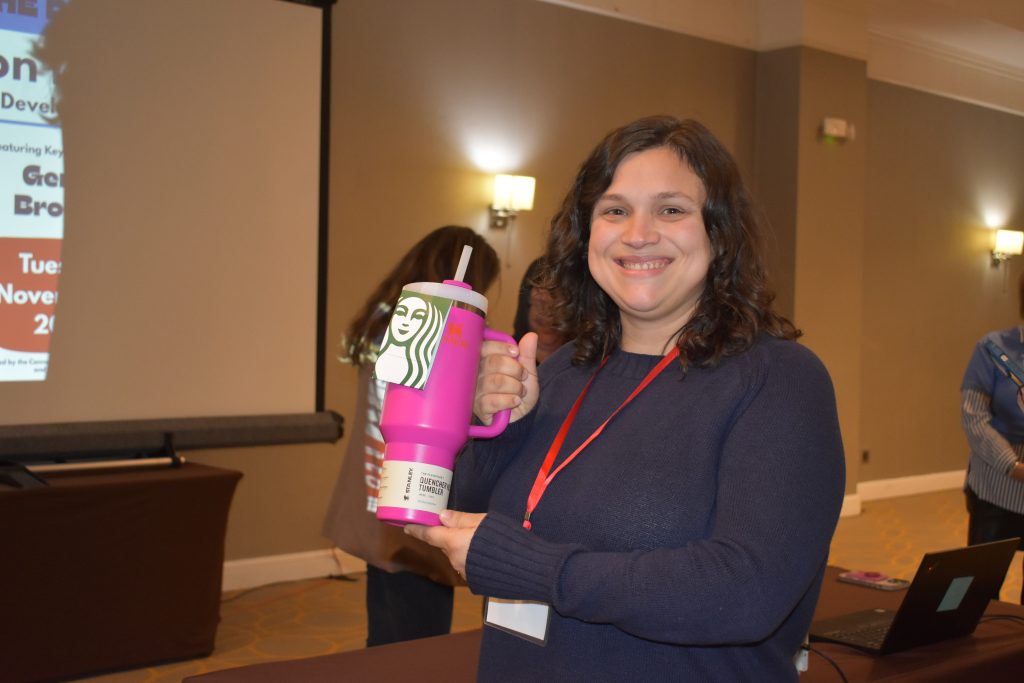
Attendees had the chance to win prizes, including Stanleys and an Apple Watch.
“A lot of professional development is done by people who haven’t been in a classroom in a very long time, and I love learning from colleagues who are currently doing the work,” said early childhood center teacher Melanie Elliott, in her 29th year with New London’s public preschool program. “As our district incorporates play-based learning, a lot of what we’re learning here today is stuff we can bring back to our classrooms.”
“I also came for the huge play component,” Andover early childhood specialist Jennie Morrell agreed. A former kindergarten teacher, she added, “It’s important that we use play in all the grades, not just preschool and kindergarten. It makes a huge difference.”
Indeed, while many conference participants work with younger students, about half teach those in grades three and up.
Manchester High School family consumer science teachers Jessica Fallon, a first-year culinary and baking teacher, and Zelma Woodson, international foods and culinary instructor, are among them.
“The professional development offered here is relevant to the work I do,” said Fallon.
“When people think of play, their minds often go to younger children—but older students love to play too,” Woodson added. “We use bingo to help students introduce themselves to each other and get to know their classmates. They might have to find someone who has cooked before or someone who plays the same sport, and they love talking to each other in the context of a game. I’m here to pick up some new engagement tools to facilitate learning.”
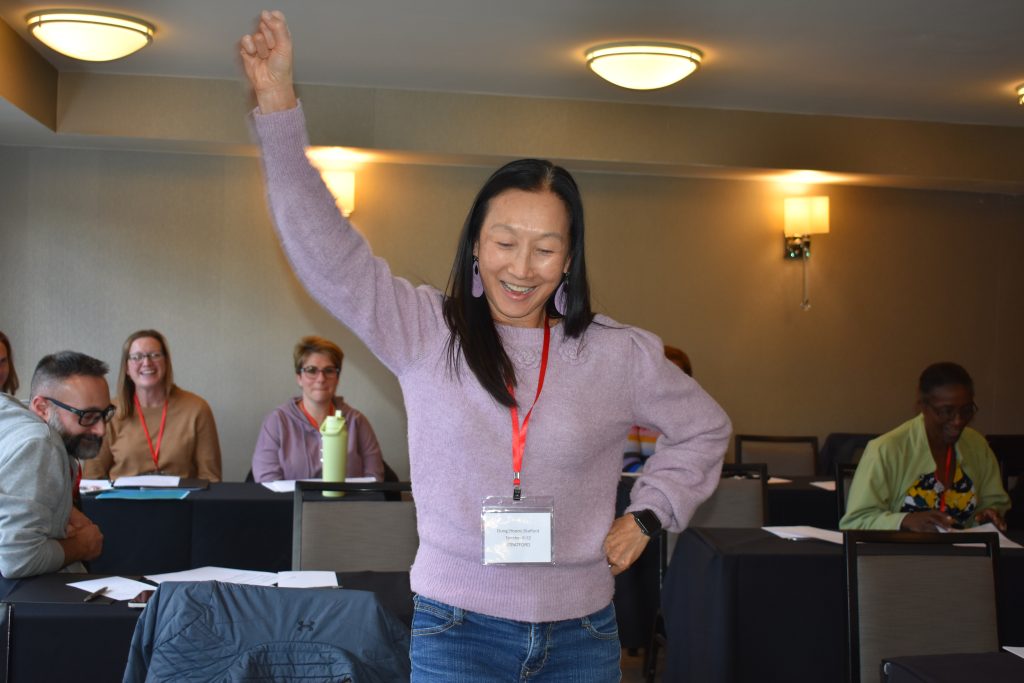 “This is always a good experience, talking to other teachers and learning how to hone my craft and bring joy into learning,” Stratford middle school math teacher Mike Kolinsky agreed.
Fireside chat
The day of learning also included a fireside chat with Dias and CEA Vice President Joslyn DeLancey.
“There should be no greater space for a teacher, student, or administrator—a school that is joyful and a place where you belong, where you can feel safe to make mistakes as you learn,” DeLancey said.
“Positive school climate doesn’t just happen,” Dias noted. “It’s intentional. We need to build the spaces we want.”
“If your school ranks at the top for academics but also for high rates of student mental health issues and suicide, the school is not thriving,” DeLancey stressed. “What gives me hope in this moment is that we’re all here in this room—teachers, leaders, administrators,” she said, adding, “I was just interviewed by EdWeek because of the legislation we got passed in Connecticut mandating play-based pedagogy in the early grades and allowing for it in the older grades as well. We should all be proud that we made that happen.”
Read more about the conference’s breakout sessions in the December-January issue of the CEA Advisor.