Connecticut leaders are stepping up to counter new federal caps on graduate student loans that could limit access to advanced degrees for future public service professionals. This week, both Senator Richard Blumenthal and Governor Ned Lamont took action—calling for remedies and advancing solutions aimed at protecting students pursuing careers in education, nursing, social work, and other vital fields.
Lamont has proposed legislation to create the Connecticut Supplemental Graduate Student Loan Program in response to federal legislation impacting student loans for public service graduate students. The state-funded program would ensure that students in Connecticut perusing graduate degrees to work in public service careers including education, social work, nursing, physical therapy, and others impacted by the recent federal changes continue to have access to low-interest loans to cover their tuition.
“For decades, lower and middle-income students have depended on these low-interest loans to seek careers in good-paying professions, and now these recent federal changes are going to make graduate programs out of reach for many students who dream of pursuing a graduate degree,” the governor said.
Earlier this winter Connecticut lawmakers advanced a similar state-level solution designed to preserve access to affordable financing and protect the future of the state’s public service workforce in response to actions by the Trump administration
In July, President Trump signed the One Big Beautiful Bill Act into law, which includes the most expansive changes to federal student loan borrowing and repayment in decades. This includes establishing new limits on how much graduate students can take on in federal student loans based on whether the degree program is categorized by the U.S. Department of Education as a “graduate” or “professional” program.
In November, the U.S. Department of Education released its definition of programs it will classify as “professional.” That definition includes pharmacy, dentistry, veterinary medicine, chiropractic, law, medicine, optometry, osteopathic medicine, podiatry, and theology. It does not include teaching or a number of other degrees that will be defined as “graduate” and subject to lower federal borrowing caps, which are unlikely to cover the full costs of tuition.
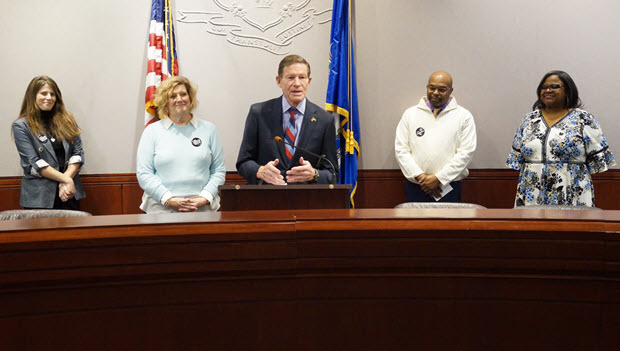
“It’s the Big Beautiful Bill in Trump’s parlance, but I think it’s one big betrayal,” said Senator Blumenthal at a press conference on Monday. “It will deprive literally thousands of people from pursuing studies that are essential to their being in the classroom or aiding students in one way or another.”
“I am a proud graduate of the University of Connecticut with a graduate degree that has been necessary for my ability to be an exceptional educator,” said CEA President Kate Dias. “What does it mean to be an exceptional educator? What is required of us? I think we all recognize it’s that ongoing education. It’s that extra amount of learning. This administration’s efforts, what they are doing to de-professionalize education, is intentional. They’re attempting to really identify that education is unnecessary.”