
“I have seen a noticeable difference in my classroom since Torrington removed cell phones from schools,” said teacher and parent Maggie McGillicuddy. “I’ve actually had some kids tell me it’s nice to take a break from all the nonsense that happens when you have a cell phone in your hand.”
McGillicuddy was one of numerous educators who shared their support for statewide phone-free schools legislation during an Education Committee public hearing last week.
McGillicuddy said that part of the success of Torrington’s policy is due to the fact that the district was careful to involve all stakeholders as they developed it.
“Our administration, our teachers, our support staff, and our central office—we’re all on board with the board of education policy, and we communicated very clearly with the parents, so we had buy-in from all of these stakeholder groups.”
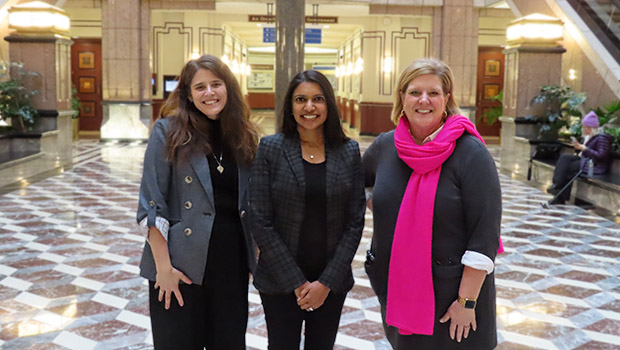
CEA Vice President Joslyn DeLancey (pictured above with Anxious Generation’s CT Ambassador Deepa Javeri and CEA President Kate Dias) said that in districts around the state that have already instituted a bell-to-bell ban on cellphones in schools the positive impact has been considerable. Some districts have already instituted strong policies, but in other places phones are still acting as a distraction for students.
“What we want to see is legislation that sets a consistent, state-wide standard that cell phones do not belong in our classrooms,” DeLancey said.
CEA has joined with AFT Connecticut, The Anxious Generation Movement, Distraction Free Schools Policy Project, and the Becca Schmill Foundation to form The Phone-Free CT Coalition. Together, the partners aim to ensure that legislators adopt a comprehensive, bell-to-bell phone-free schools mandate for students in this year’s legislative session.
“The science on this issue is staggering,” DeLancey said. “There is a growing body of peer reviewed, published research telling us that constant student access to personal electronic devices is addictive. The effects negatively impact students’ ability to focus and learn, create unwanted distractions in the classroom, and are detrimental to youth mental health. Now more than ever, educators, academics, and pediatric health professionals are calling for clear restrictions on students’ access to these devices during instructional time.”
Manchester Education Association President James Tierinni said that his district also has had phone-free schools for several years and that it’s been beneficial to students in many ways.
“Not only do I see, as an educator, academic gains in my students that have been made in the past few years, but I also see the social and emotional health of kids improving.”
He said that before the ban, as a high school math teacher, when he would ask his students to break into small groups to work together on problems, the first thing they would do would be to check their notifications, and anytime their phone buzzed they would be quick to pick it up.
As tweens and teens, Tierinni said that students have not yet developed the skills they need to prioritize a focus on schoolwork.
“With phone-free schools, they don’t have to make a choice, it’s made for them, and now they’re able to focus on what they need to focus on, which is their education.”
The Education Committee heard testimony on two phone-free schools bills last week and will deliberate over the final language before a bill is voted out of committee.
DeLancey said that CEA recommends that the process of developing district-wide phone-free policies be transparent and inclusive of parents, students, teachers, health professionals, law enforcement, and the leaders of collective bargaining organizations representing school employees.
“This will make for a more robust policy that is tailored to the needs of a given school district,” she said. “Stakeholder input is necessary to address the concerns of families and other members of the school community, and it supports the establishment of clear metrics for data collection, impact measurement, and annual evaluation of district policies.”
She added, “Communication across the school community with students and parents is key. Rollouts should be clear, transparent, and easily accessible and include posting of the policy online in the twelve most common languages spoken by English learners in Connecticut.”
Subscribe to the CEA Daily for more about education issues before the Connecticut legislature during the 2026 session.