
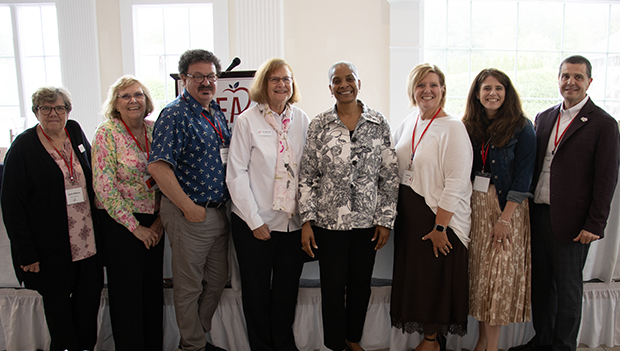
“You may be retired from the classroom, but you’re not retired from public trust,” Connecticut Secretary of State Stephanie Thomas told CEA-Retired members gathered for their annual business meeting yesterday at the Aqua Turf Club in Southington.
Thomas, the keynote speaker for the event, told retirees that their former students, their communities, and their families listen to what they have to say. “I travel all around the state almost every single day, and what I know for sure is that in this moment Connecticut needs trusted civic voices, especially when it comes to elections.”
She said that in her job, she frequently hears people say, “I’m not political.”
“I get it, and I used to feel that way too,” she said. “But government is not politics, and it’s not something separate and apart. It’s in our school budgets, our library hours, our roads, and our access to the ballot. It’s in our food, our housing, and our college education. You don’t need to be invested in politics, that’s your right, but government is already involved in our lives, and the only question worth asking is whether or not you want a voice in it.”
Thomas explained that the state has made major changes to elections in the last few years including implementing early voting, and last Friday, the governor signed legislation into law allowing for universal absentee voting and giving voters more rights in the absentee voting process. She said that misconceptions about voting abound, and retired educators can be an important voice to ensure community members know how and where to vote, and why it’s so important.
Active in retirement
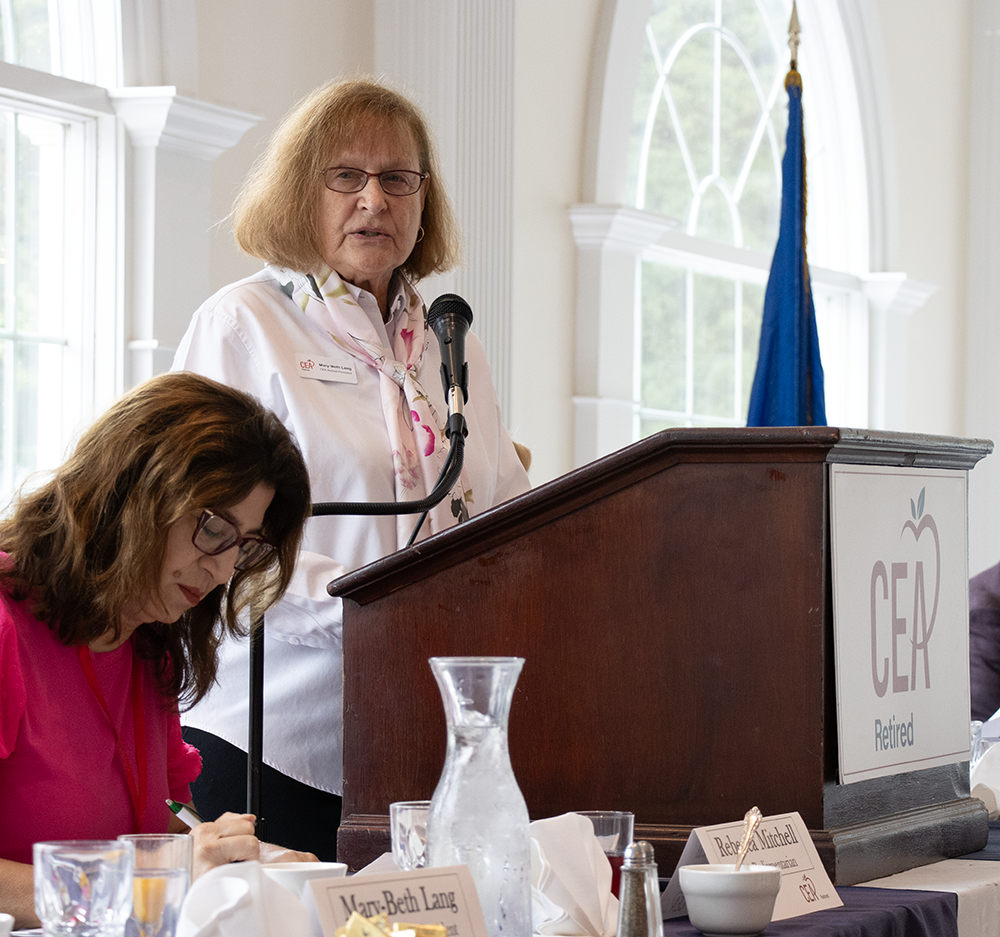
CEA-Retired President Mary-Beth Lang celebrated the many activities retirees took part in this year and the growth of the association’s membership.
CEA-Retired President Mary-Beth Lang said that members have been exceptionally active this year taking on projects from volunteering at food banks and collecting socks for people in need to advocating before the legislature on issues of importance to retired and active teachers alike.
At their meeting, retired members conducted the business of the organization by electing retired Greenwich teacher Marjorie Klar to serve on CEA’s Resolutions Committee for the NEA Representative Assembly and by passing several changes to the CEA-Retired Constitution, Bylaws, and policies.
“With all this hard-working commitment, our membership increased by 79 members this year,” Lang said. “Thank you for your continuing support of CEA-Retired.”
Not all educators understand why remaining a member of CEA is so important, even in retirement. (Click here to become a CEA-Retired member.)
Brendan Murphy, a former CEA UniServ Rep, organizer, and special education teacher, is CEA’s new retirement specialist. He told retired educators that, since January when he started his new position, 150 retired educators have reached out to him with questions and requests for advice. He was only able to help half of them, because only half were CEA-Retired members.
CEA-Retired membership also allows retired educators to maintain a voice in the association and participate on a variety of committees and commissions, including the CEA-Retired Legislative Committee, which helps to shape the priorities CEA pursues at the legislature.
Collective effort
“Our successes happen because of the collective work of our union,” said CEA President Kate Dias. “This year our efforts at the legislature changed our termination statute to finally make it fair. Those of you who had the opportunity to serve in local leadership may have had that horrible moment when you had to look at a teacher facing an unfair termination and tell them, ‘The deck is stacked against you. We’re going to suggest you walk away quietly because we can’t fight this.’ We no longer have to do that, and that’s the power of our united advocacy.”
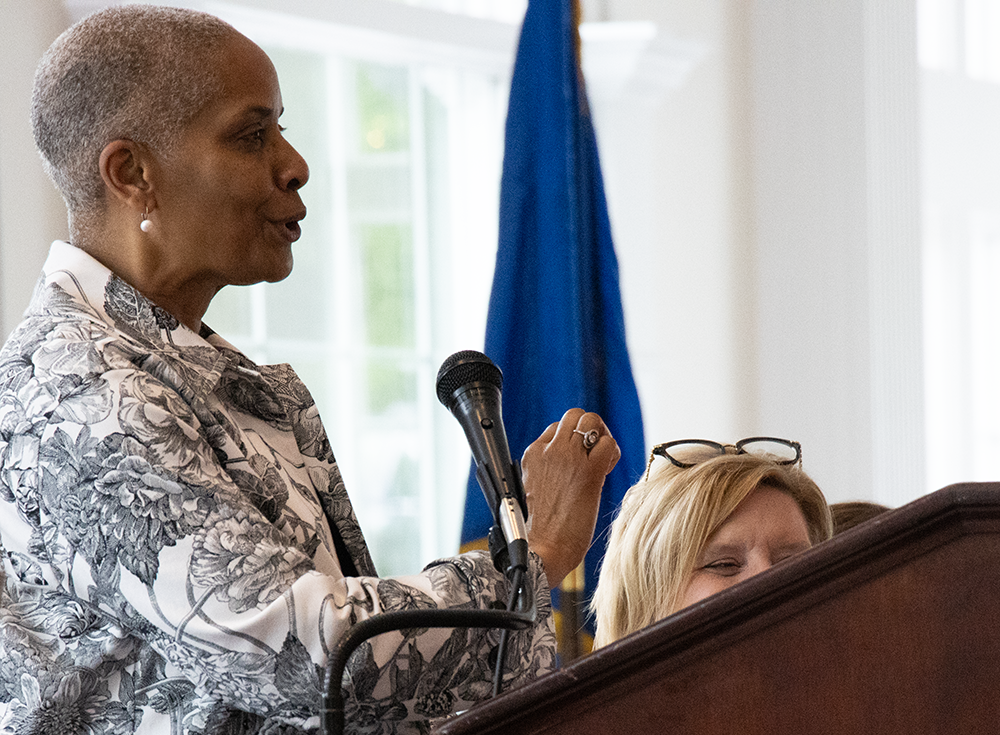
Secretary of State Stephanie Thomas talked to retirees about the impact both educators and government have on each individual.
CEA Legislative Coordinator Louis Rosado Burch shared that other wins for teachers at the legislature included additional education funding, free school breakfast for all Connecticut students, stronger workers’ compensation protections, and the strengthening of Connecticut’s Trust Act to ensure that federal immigration enforcement activities may not be carried out in sensitive community spaces, including schools, without a clear judicial warrant.
The legislature fully funded the annual pension contribution to the Teachers’ Retirement Fund, but Rosado Burch said that other CEA-Retired legislative priorities will need to be brought to the legislature again next session.
“I’m really disappointed that a couple of CEA-Retired’s legislative priorities did not pass this year,” Dias said. “The adjustment to the disability benefit for some of our disabled members didn’t go through. That was so disappointing, because it was such a small amount of money. But, you know, what? We’re not done. We’ll go back next year to work hard on getting that disability subsidy passed and to ensure that we have proper elections for the Teachers’ Retirement Board that give every educator a say in who represents us.”
“Your voice gives us the power that we need to ultimately build a better future for our students,” said CEA President Todd Jaeck. “We can only do that when we intentionally organize across the career continuum and organize aspiring educators, early-career educators, active educators, and retired educators.”
CEA-Retired members’ voices were critical in the successful passage of the federal Social Security Fairness Act that repealed WEP/GPO and ensured retired educators can receive their full Social Security benefit.
“I hope all of you are celebrating the first anniversary of receiving your first full Social Security check,” CEA Vice President Joslyn DeLancey said. “The collective wisdom and advocacy in this room always inspires me. It challenges me to think about how I can ensure a healthy and thriving retirement for all of our members. A healthy and thriving retirement is critical to teacher recruitment and retention, and to ensure that the time and service that you’ve put into public education is really recognized.”