

Bloomfield is one of the many towns in the state that has struggled with its education budget this spring. Through outreach and organizing Bloomfield Education Association members, students, parents, and community members have managed to convince the Town Council to add funding back to the education budget, but the district is still facing cuts if nothing changes.
At the annual town meeting on May 4, the Town Council approved an education budget that represents a 2.91% increase, significantly less than the 4.75% the superintendent had asked for and the Board of Education approved. Under that budget, eleven teachers have received reduction in force notices and class sizes and caseloads will increase.
“As of June 18th, our last day of school, I will no longer have a job in the Bloomfield Public Schools if this budget moves forward,” first-year teacher and Bloomfield Public Schools graduate Abigail Mullings told the Town Council at the May 4 meeting. “Right now, my second graders are learning about citizenship, and they’re learning about what it means to be an active member in our society. I hope that me coming up here is a good representation to them about how your voice matters. Public schools are more than just where students come to learn. They come here to grow and build relationships and memories that shape them into who they are meant to be. They are the future of our town. They will go on to make a difference anywhere they choose. That was true for me as a student, and it is why I strive to create that same environment in my classroom every day.”
“As a product of the Bloomfield Public Schools I experienced firsthand the power of a supportive and enriching educational environment,” fifth-grade teacher Kendra Mattison said. “I’ve learned so much as a student and I continue to grow every day as a teacher. While I could have chosen to work in any district across Connecticut, I made the intentional decision to return to Bloomfield to give back to the community that has given me so much. As an educator, I see how critical it is to keep class sizes small so that every child receives the attention they deserve. Beyond the classroom, I had the pleasure of bringing back the girls’ middle school basketball team. The students work incredibly hard and there’s so much room for growth. They’re excited to return next year and more students are eager to try it out. Reductions in funding risk taking away opportunities like these that keep students engaged, motivated, and connected to their school community.”
In April, when the extent of the threat to the school budget became clear to the Bloomfield Education Association—at one point the Town Council was considering an only slightly more than 1% increase because of a misguided assumption of how much additional ECS funding the state was going to provide—BEA President and CEA Secretary Gail Jorden said she knew it was time to organize. She contacted all members and reached out to teachers who live in town to speak out at Town Council meetings. Due to second jobs and other commitments, some couldn’t attend the evening meetings, so other BEA members read their prepared statements aloud to town councilors. The middle school marching band played before one meeting and the high school jazz band performed as residents entered another.
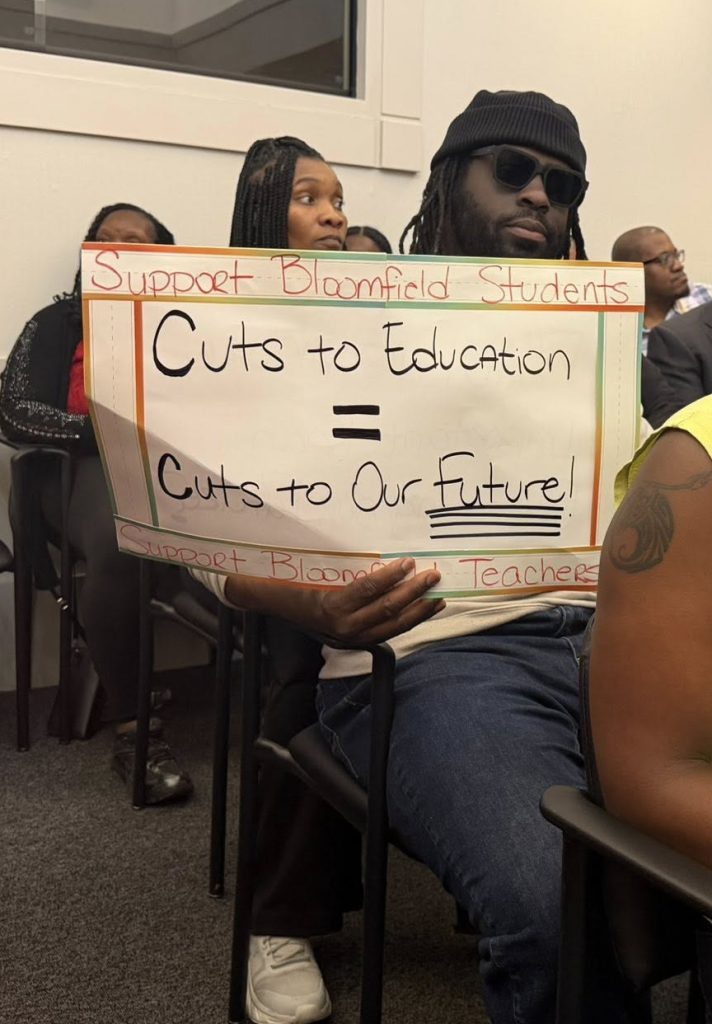 Jorden told the Town Council she was proud of all the members who came to speak at meetings and had sent emails. Their voices, along with comments from students and community members, persuaded some Town Council members to add money back into the education budget.
“I had the challenging job of calling 11 people to tell them, ‘Sorry, as of June 18th, you will no longer be working for Bloomfield Public Schools,'” she said. “Our class sizes are definitely going to be increasing. Our services will definitely be decreasing. There’s no way that that’s the solution. We need to do better for our students.”
Special education teacher Shonelle Martell was one of the Bloomfield residents who couldn’t attend the May 4 meeting. Her colleague, academic interventionist Lynne Dumas, read her comments to the Town Council.
“I’m extremely concerned about the proposal to increase caseload caps for special education teachers,” Martell wrote. “My role is not limited to classroom instruction. It requires a rigorous cycle of direct teaching, progress monitoring, and detailed documentation. When caseloads are increased, this delicate balance is destroyed. It eliminates any hope for healthy work-life balance, directly fueling teacher burnout. We are already facing a national teacher shortage. By overextending our current staff, the town risks a high turnover rate. This creates a secondary crisis. When a teacher leaves due to burnout, it is the students who suffer most as their mandated services are disrupted while the district struggles to find qualified replacements who then inherit an even more overwhelming system. Short-term savings in the education budget will inevitably lead to long-term cost increases, including potential legal challenges regarding service delivery and a decline in the educational reputation that draws families to Bloomfield.”
The BEA has done what they can to advocate for increased education funding at this point, and now community members, many of whom think the town is spending too much on administrative expenses and not enough on education, continue the fight, attempting to force a referendum vote. In Bloomfield, the budget is customarily adopted by a vote of the Town Council and does not go to residents for a vote.
Jorden offers advice to other local leaders who find themselves in the midst of budget battles.
“You have to make sure that you know your community and what moves the people within your community,” she says. “The town council, board of education—really understand what truly motivates them and what they’re going to care about. Don’t let others tell you the fight is not worth it. The words that we spoke and the organizing that we did has inspired Bloomfield residents to take the baton and keep up the fight.”
“These decisions are not easy and they’re not taken lightly, but as you move forward, I ask that you keep the students in the center of your conversations,” Mullings, the teacher facing the end of her Bloomfield teaching career, told the Town Council. “Think about the classrooms that they’re going to walk into next year, what the support is going to look like, about the kind of experiences we want them to have. You want school to be fun. You want it to be extraordinary. Without those extras, students aren’t going to have many of those moments. Our students deserve to be in a classroom where they feel supported, and they should have every opportunity to succeed.”