
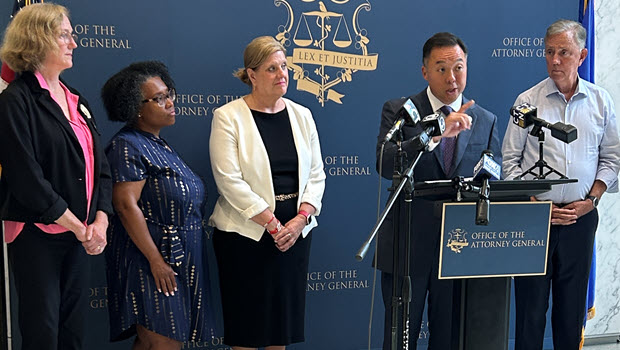
A U.S. District Court judge has granted a temporary restraining order that blocks the U.S. Department of Education from unlawfully terminating congressionally approved school-based mental health grants.
The order in the case joined by Attorney General Tong and a coalition of 14 state attorneys general comes just days before the Department of Education would have begun terminating grants providing critical mental health services to Connecticut public school students at the end of July. Terminating the grants would have resulted in the projected loss of $3 million used to support social workers in Hartford, New Britain, Vernon and Waterbury schools through 2029.
“We are grateful for yet another court victory protecting the critical federal mental health grants our students and schools so desperately need,” said CEA President Kate Dias. “These funds provide essential support to students who are struggling and help put social workers, counselors, and psychologists in our schools where they are needed most. With students facing increasing behavioral and mental health challenges, we cannot afford to lose any money dedicated to helping them succeed. We thank Connecticut Attorney General Tong for continuing to stand up for our students, educators, and public education and ensuring Connecticut receives the resources Congress approved to help students thrive.”
“Another victory against the Trump administration. The court has once again stepped in to stop this unlawful attack on our schools and students. These grants were approved by Congress to provide critical mental health services to children. Trump has no authority to hold them hostage for his own political agenda,” said Attorney General Tong.
In the wake of devastating school shootings, members of Congress from both parties came together to appropriate $1 billion to permanently bring 14,000 mental health professionals into U.S. schools most in need, especially in low-income and rural communities. The programs have been an incredible success. In their first year, the programs provided mental and behavioral health services to nearly 775,000 elementary and secondary students nationwide. Sampled projects showed real results: a 50% reduction in suicide risk at high-need schools, decreases in absenteeism and behavioral issues, and increases in positive student-staff engagement.
However, over the past 15 months, the U.S. Department of Education has interfered with these goals by adding funding uncertainty and roadblocks that make it harder for grantees in Connecticut and the other coalition states to plan and perform their grant projects. In April 2025, the department notified these grantees that their grants would be discontinued for allegedly conflicting with the Trump administration’s new priorities. The department later revealed the grants had been targeted for their perceived support for diversity, equity, and inclusion.
Connecticut has gone to court repeatedly to fight for these mental health grants and has won six favorable rulings against the administration so far. In July 2025, Attorney General Tong joined the coalition in filing a lawsuit in the U.S. District Court for the Western District of Washington against the department over the discontinuation of the grants. In December 2025, the coalition secured an order declaring the department’s discontinuations were unlawful and requiring it to make new continuation decisions. The court also issued a permanent injunction that prohibited the department from implementing the discontinuations “through any means.”